The Signal From Fargo: How John Deere’s StarFire 7500 Became the Coolest Thing Made in North Dakota
277 Views
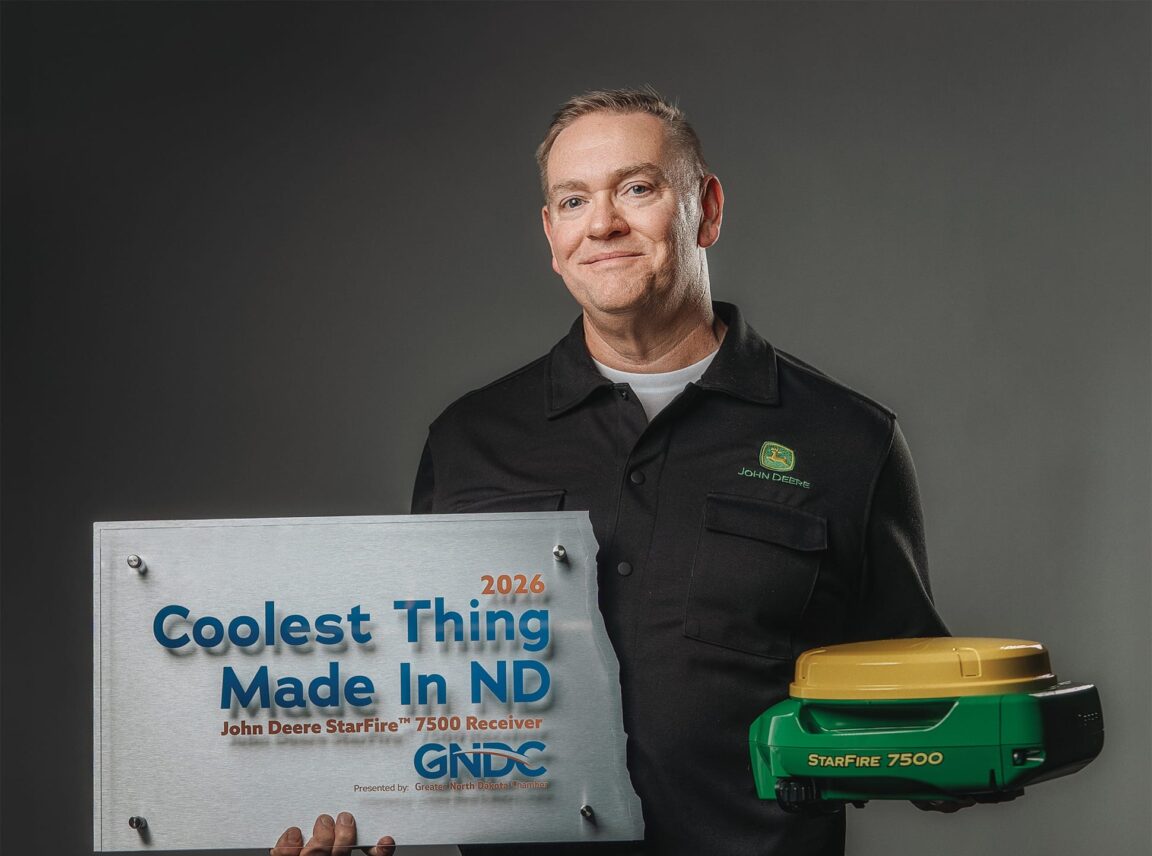
Matt Potter, Director of Engineering, John Deere
About The Coolest Thing Made in ND Award
The Greater North Dakota Chamber’s Coolest Thing Made in ND Showcase is a statewide celebration of North Dakota’s manufacturing sector, highlighting innovative, high-quality products made by local companies and the workforce behind them. Hosted by the GNDC Foundation in partnership with Walmart, the showcase is part of the broader “Coolest Thing Made in North Dakota” contest, which uses an online product gallery and public voting to spotlight the strength and diversity of manufacturers across the state.
From a distance, it looks deceptively simple.
A smooth green-and-yellow dome sits atop the cab of a tractor or combine, quietly riding along as the machine moves through acres of farmland. Most people driving past a field might never notice it. Farmers certainly do.
Inside that dome is one of the most advanced positioning systems in agriculture. It’s a device capable of determining a machine’s location on Earth with sub-inch accuracy using signals from satellites thousands of miles above the planet.
The technology is called the StarFire 7500, and it was recently recognized as the inaugural winner of the “Coolest Thing Made in North Dakota” award.
For John Deere’s Director of Engineering Matt Potter, the recognition was both exciting and meaningful.
“I mean, it was really exciting,” he said. “We do a lot of things in technology here in Fargo, but getting recognized by the state for this one—‘the coolest thing made in North Dakota’— that says it all.”
More than anything, for Potter, the award reflects the work of hundreds of engineers, designers, and manufacturing teams who developed and built the technology locally.
“It’s great recognition for the engineering teams that design it and the manufacturing teams that produce it,” he said. “It was a great honor.”
But what makes the award even more remarkable is that the device isn’t just used in North Dakota or even the United States. It’s used everywhere
“We’ve got these StarFire 7500s on all seven continents,” Potter said. “Hundreds of thousands of them have been produced, and they go all over the world.”
The Technology That Guides Modern Agriculture
The StarFire 7500 is part of a category of technology known as Global Navigation Satellite System receivers (GNSS receivers). Most people know the concept by a simpler name, GPS
But GPS is actually only one piece of a much larger network.
“There are multiple satellite constellations,” Matt said. “The United States has GPS satellites, but there are others as well. The European Union, China, and Russia. All of them have positioning satellites orbiting the Earth.”
Each constellation consists of dozens of satellites circling the planet in what’s known as mid-Earth orbit, roughly 12,000 miles above the surface. Those satellites continuously broadcast radio signals.
The StarFire receiver listens to them.
By measuring tiny differences in the time it takes those signals to arrive, the system can calculate a machine’s position on Earth with astonishing precision.
“Sub-inch accuracy anywhere in the world,” Matt said.
In agriculture, that level of precision is a big deal
It enables technologies like AutoTrac, John Deere’s automated steering system, which allows tractors and combines to follow perfectly straight paths across fields. It ensures rows are spaced precisely, inputs are applied exactly where needed, and equipment doesn’t overlap areas already covered.
The result is better yields, lower costs, and less wasted fertilizer, seed, and chemicals.
But achieving that level of accuracy isn’t simple. In fact, the challenge begins with the signals themselves.
You’re doing very precise electronics while trying to resolve very difficult signals, and you have to do it in an environment that’s incredibly rugged.”
Listening For Whispers In A Stadium
Satellite signals may travel thousands of miles, but by the time they reach Earth, they’re incredibly faint.
To explain the difficulty, Potter uses an analogy that anyone in Fargo can appreciate.
“Imagine you and I are sitting in the FargoDome during an NDSU Bison game,” he said.
The stadium is roaring with tens of thousands of fans.
Now imagine trying to hear someone whisper across the room.
“That’s basically what these signals are like,” Matt said. “They’re incredibly faint, buried in noise.”
The receiver must isolate those signals, interpret them, and calculate a position with extreme precision in real time. And it has to do it while mounted on equipment operating in one of the harshest environments imaginable. Agricultural machinery endures dust, heat, rain, snow, constant vibration, and rough terrain. Yet the receiver must remain accurate and reliable through it all.
“You’re doing very precise electronics while trying to resolve very difficult signals,” Matt said. “And you have to do it in an environment that’s incredibly rugged.”
Even more challenging, the technology has to remain affordable for farmers. Unlike industries where expensive hardware might be acceptable, agricultural technology must deliver real economic value.
“We have to do this cost effectively,” Potter said. “Farmers need to get the value out of the technology.”
That combination of precision, durability, and affordability is what makes designing systems like the StarFire 7500 so complex.
A Multi-year Leap Forward
The StarFire 7500 didn’t appear overnight. Like most advanced technologies at John Deere, it followed a multi-year development cycle, building on earlier versions.
“You can even tell by the name,” Potter said. “This is the 7500. There was a version before it, and a version before that.”
Each generation improves on the last
Interestingly, the biggest leap in the newest model isn’t necessarily the ultimate level of accuracy. Previous generations were already capable of sub-inch precision. The real improvement lies in how quickly and reliably the system reaches that accuracy.
When a machine enters the field, the receiver begins calculating its position using satellite signals. The time it takes to reach full precision is known as “pull-in time.”
Faster pull-in times mean machines can begin operating precisely almost immediately, reducing delays and improving efficiency during critical field operations.
The 7500 also improves signal reliability and maintains accuracy even in challenging conditions.
Another major advancement comes from the receiver’s ability to listen to more satellite signals than previous generations.
As more positioning satellites are launched globally, receivers can tap into additional data sources, improving both accuracy and stability.
“That’s how we improve performance,” Potter said. “By listening to more signals coming from space.”
But even with better satellites and improved hardware, the technology only works because of the people behind it.
And many of them are based right here in North Dakota.
Fargo To The World
One of the most surprising aspects of the StarFire 7500 isn’t just the technology itself. It’s where it’s built.
For many people, Fargo isn’t the first place that comes to mind when they think about advanced robotics, satellite navigation systems, or precision engineering
But inside John Deere’s Fargo operations, teams of engineers are designing and manufacturing technologies that guide machines across millions of acres around the world.
“The designs are done within John Deere,” Potter said. “We have a really strong model of vertical integration. We design the hardware, the software, and we manufacture it within the company.”
That approach allows the company to tightly control performance, cost, and reliability.
We all benefit every day from the food that gets grown—the fiber in our clothing, the infrastructure that gets built. Being able to serve the people WHO do that work is really motivating.”
A Career In Robotics— Applied To Agriculture
Matt didn’t grow up on a farm.
But he did grow up in the Midwest, surrounded by agriculture and aware of its importance.
His path into the industry came through another passion of his, robotics.
“What I’ve done my whole career is robotics and technology,” he said.
Over time, he found that agriculture offered one of the most meaningful applications of those technologies. Automation, sensors, and intelligent systems could help farmers work more efficiently, sustainably, and profitably.
“I’ve worked in other industries before,” Potter said. “But this is by far my favorite. When we do a good job, it helps farmers be more productive. It helps them run their operations better.”
And ultimately, that impacts everyone.
“We all benefit every day from the food that gets grown,” he said. “The fiber in our clothing, the infrastructure that gets built. Being able to serve the people who do that work is really motivating.”
Feeding The Future
The challenges facing global agriculture are enormous.
By some estimates, the world will need to produce 70 percent more food by 2050 to meet growing population demands. At the same time, farmers are working with limited land, rising costs, environmental pressures, and an increasingly tight labor market.
And that’s exactly where companies like John Deere are focusing their efforts
“We can continue to incorporate more technology into agricultural production,” Potter said. “There are still a lot of opportunities.”
Those opportunities revolve around three key areas:
Data
Automation
Autonomy
Data-driven farming is already transforming how producers plan their operations. Sensors, satellite imagery, and field-level analytics help farmers make decisions based on measurable conditions rather than guesswork.
Automation reduces the manual workload required to operate large machinery across thousands of acres.
And autonomym, the ability for machines to operate independently, is increasingly becoming a realistic possibility.
Together, these technologies aim to help farmers accomplish more with fewer resources.
“Labor scarcity is a real challenge,” Potter said. “But we also need to increase productivity. Technology will help close that gap.”
And as those capabilities continue to evolve, positioning technology like the StarFire receiver remains a critical foundation.
Without knowing exactly where a machine is located, none of those systems can function.