Staying Ahead of the Acre: How Maple River Coop is Built for Speed
343 Views
In agriculture today, timing isn’t just important—it’s everything. Weather windows are tighter. Margins are thinner. Decisions that once took weeks now happen in hours. For CEO of Maple River Coop Alex Richard and the cooperative he helps lead, innovation isn’t a buzzword or a shiny new tool. It’s the discipline of staying ahead of the grower—every single day.
“We have to make hay when the sun shines,” Alex said. “When field conditions are right, when planting season hits, we have to be ready. If we’re not efficient, we’re holding our patrons back.”
That mindset defines how the cooperative operates across its many divisions: fertilizer, crop protection, grain handling, full-service agronomy, and application. Each area is distinct, but all of them are built around the idea of putting the right product in the right place at the right time, without slowing the farm down
Innovation That Actually Works in the Field
In an industry flooded with new technology, not everything is worth adopting. Alex is clear about that.
“There’s always something new coming out,” he said. “But we have to vet it. It has to be usable. We have to be able to implement it and execute it.”
That practical filter has shaped how technology is woven into daily operations. Fertilizer floaters are GPStracked in real time, ensuring products are applied to the correct fields with accuracy. Each floater is equipped with an iPad, receiving digital job orders that eliminate guesswork and reduce errors.
From the cooperative’s perspective, that internal technology matters just as much as what patrons see on the outside. Accuracy, speed, and accountability all start behind the scenes.
“If we don’t get it right internally, it doesn’t matter what tools the customer has,” Alex said.
When field conditions are right, when planting season hits, we have to be ready. If we’re not efficient, we’re holding our patrons back.” – Alex Richard
Putting Information in the Patron’s Hands
On the customer-facing side, the cooperative has focused heavily on communication—specifically, removing friction from it.
A dedicated app connects patrons directly to their accounts, giving them real-time access to invoices, statements, grain contracts, scale tickets, and digital signatures. But more importantly, it closes the communication gap during critical moments.
“When we finish spreading a field, the grower gets a text immediately,” Alex said. “They know it’s done. They know they can go work it in. There’s no waiting, no wondering.”
That same platform allows agronomists and grain merchandisers to send quick messages, daily grain bids, or market updates—without relying on phone calls that may or may not get answered in the middle of a busy day. Patrons can respond just as easily, turning communication into a two-way, real-time exchange.
That same platform allows agronomists and grain merchandisers to send quick messages, daily grain bids, or market updates—without relying on phone calls that may or may not get answered in the middle of a busy day. Patrons can respond just as easily, turning communication into a two-way, real-time exchange.
In an industry where minutes matter, that speed changes everything.
The Biggest Shift: Velocity
Ask Alex what has changed most in the last five to ten years, and his answer is immediate.
“Speed,” he said. “The velocity at which things happen now.”
Farmers are moving faster than ever—planting faster, harvesting faster, making decisions faster. To keep up, cooperatives have had to scale alongside them, investing in larger equipment, more efficient application methods, and systems that reduce downtime.
“We have to stay ahead of them,” Alex said. “That’s the goal. If we’re behind, we’re the bottleneck.”
Staying ahead isn’t just about machinery. It’s about staffing, logistics, and infrastructure—having enough people, enough storage, and enough capacity to absorb peak demand without slowing anyone down.
That philosophy shows up most clearly during harvest, when grain handling becomes mission-critical.
“Fast unloading and receiving is huge,” Alex said. “We want trucks back in the field as fast as possible so combines don’t stop. That’s something we really pride ourselves on.”
Did You Know?
In 2024, Maple River Coop bought out its AGP partnership and became 100% ooperative-owned.
Pressure, Precision, and Smarter Decisions
While technology has accelerated nearly every aspect of modern agriculture, the economic reality behind it has become more complex and more constrained.
Over the past 18 to 24 months, Maple River Coop has been navigating a difficult environment shared across the ag sector that includes rising input costs paired with falling commodity prices.
“Margins are tight across the farm gate,” he said. “Fertilizer costs are up. Chemical costs are up. Grain prices have come down. That squeeze affects every decision.”
For a full-service cooperative, that pressure creates a delicate balance. Patrons still expect the same level of service, speed, and expertise, but they’re also asking tougher questions about where their dollars are going and what kind of return they can realistically expect.
That’s where innovation becomes less about adding more and more about choosing better.
Helping Patrons Spend Smarter
Rather than pushing inputs for the sake of volume, the cooperative has leaned into its advisory role by using data, agronomy expertise, and fieldlevel insight to help growers invest where it matters most.
“We try to offer recommendations that help them spend that dollar wisely,” Alex said. “Where are they going to see a return? Where does it actually make sense?”
That approach shows up in precision agriculture tools like satellite imagery, yield mapping, and variable-rate prescriptions. Instead of blanket applications, inputs are tailored to field variability.
But data alone isn’t enough.
“There’s a lot of data out there,” Alex said. “The key is having someone process it, interpret it, and turn it into something usable.”
That human layer—agronomists who understand both the technology and the realities of farming—is what bridges the gap between raw information and practical decision-making.
When Technology Moves Faster Than Regulation
Not every innovation challenge is economic. Some are regulatory, and a few areas highlight that tension more clearly than drones.
The technology itself is ready. The potential is obvious. But implementation hasn’t always been straightforward.
“We’ve seen technology outrun regulation,” Alex said. “That’s been an industry-wide struggle.”
Licensing requirements, approvals, and airspace rules slowed adoption early on, even as drone capabilities advanced. In the past year to year-and-a-half, the FAA has streamlined parts of the licensing process, making it easier and faster for operators to get approved.
That progress has helped, but limitations remain.
“Drone swarming is still restricted,” he said. “From an efficiency standpoint, that holds things back.”
For cooperatives focused on speed and scale, those constraints matter. Every delay, every limitation affects how quickly new tools can move from promise to practice.
Still, Alex remains pragmatic. Progress, even incremental, is progress, and the industry continues to push for regulations that keep pace with innovation.
There’s a lot of data out there. The key is having someone process it, interpret it, and turn it into something usable.” – Alex Richard
What’s Next: Data, AI, and Decision Support
Looking five to ten years ahead, Alex doesn’t hesitate when asked what excites him most.
“AI,” he said. “That’s the big one.”
The cooperative already works with enormous amounts of data—field trials, yield maps, satellite imagery, and application records. The next step isn’t collecting more of it, but using it better.
“There’s going to be a lot of data we have to look at,” Alex said. “The goal is figuring out where it actually helps our patrons see a return.”
AI-powered analysis has the potential to identify patterns, refine recommendations, and support more precise decisionmaking across entire operations. But, as with every other tool the cooperative adopts, Alex emphasizes restraint and realism.
“It still comes back to making sure it works in the field,” he said.
Scale, Infrastructure, and Being Ready When It Counts
Innovation often gets framed as software, data, or emerging technology. But for Alex and the cooperative, some of the most important investments are still physical—steel, concrete, storage, and people. When the season hits, there’s no workaround for capacity.
“We do a lot of stuff,” Alex said.
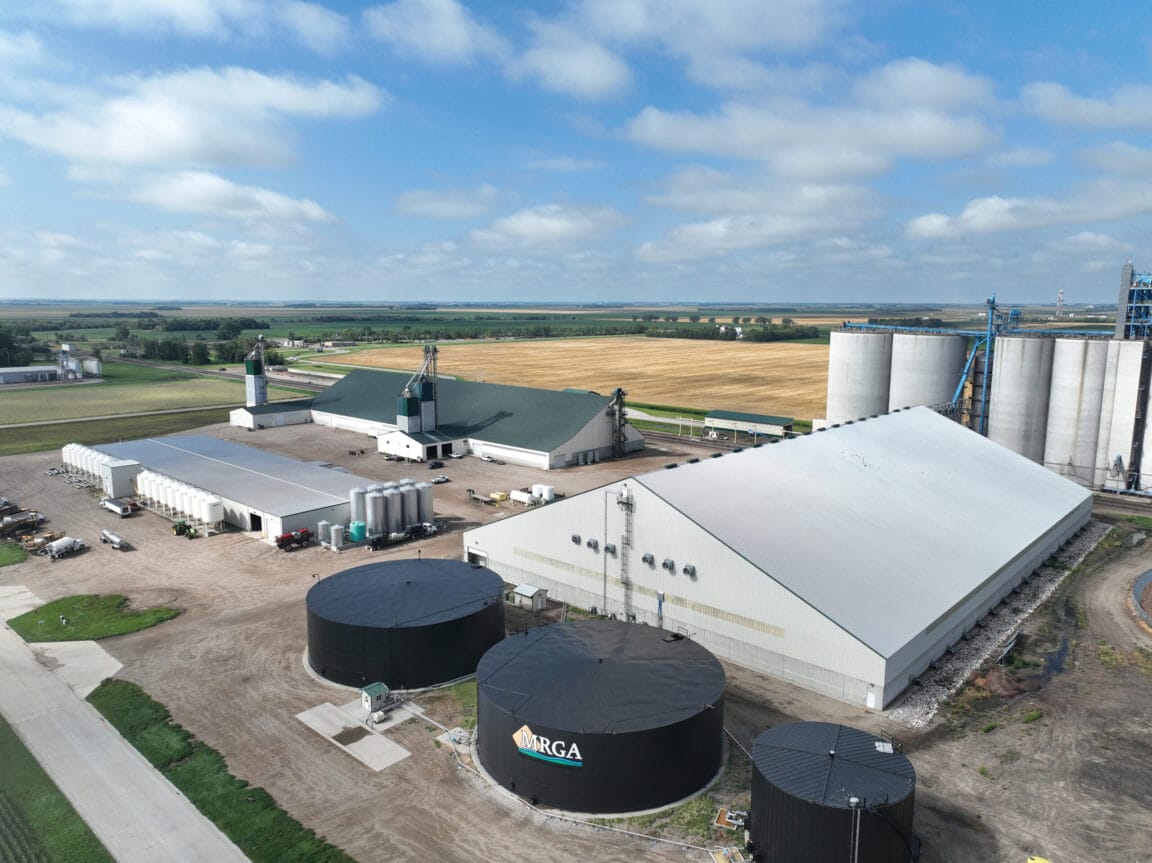
The cooperative operates nine grain locations stretching from Valley City, ND down to Rosedale, MN, creating a regional footprint designed to meet growers where they are. Across those sites, the cooperative maintains roughly 17 million bushels of licensed commercial grain storage, giving patrons flexibility at harvest and reducing bottlenecks when timing is tight.
That infrastructure is paired with speed. Fast receiving, efficient unloading, and systems designed to move grain quickly back into the field aren’t just conveniences— they’re competitive advantages.
“Our goal is to keep combines running,” Alex said. “If trucks are waiting, the whole system slows down.”
On the agronomy side, the cooperative operates two major centers—its main location in Castleton, ND, and a second facility in Barnesville, MN. Together, those hubs support both product supply and application at scale.
The cooperative maintains approximately 80,000 tons of fertilizer storage and deploys 16 fertilizer floaters during the spring application season. Each unit is integrated into the cooperative’s GPS and job-management systems, allowing for accurate placement, real-time tracking, and efficient routing.
When windows are short, and acres are many, that combination of equipment, technology, and coordination becomes essential.
“You don’t get second chances in spring,” Alex said. “You have to be ready.”
Fertilizer by the Numbers
~80,000 tons of fertilizer storage
16 fertilizer floaters in spring
Did You Know?
Over the past decade, the coop has returned nearly $10 million in patronage to its farmer-owners.
The People Behind the Process
Behind every system is a workforce built to flex with the seasons. The cooperative employs about 70 full-time team members, supplemented by roughly 30 seasonal and part-time employees during peak periods.
That staffing model allows the organization to surge when demand is highest—planting, spraying, harvest—without sacrificing service quality or safety
“Our whole focus is staying ahead of the patron,” Alex said. “That takes people just as much as it takes equipment.”
Training, communication, and alignment matter just as much internally as they do externally. When floaters roll, bins fill, and markets move quickly, everyone has to be operating from the same playbook.
Did You Know?
The cooperative operates nine grain locations across North Dakota and Minnesota, with roughly 17 million bushels of licensed commercial storage.
Be ready. Be efficient. And don’t be the thing that slows the farmer down.” – Alex Richard, on MRGA’s company mission.
Looking Ahead
As agriculture continues to evolve, the pace isn’t likely to slow. Markets will keep moving. Regulations will keep shifting. Technology will keep advancing.
But the cooperative’s strategy remains steady: combine scale with precision, speed with accuracy, and innovation with accountability
Because at the end of the day, Alex says, the mission is simple.
“Be ready. Be efficient. And don’t be the thing that slows the farmer down.”