


Ryan Raguse has agriculture in his DNA. Growing up on his family’s sixth-generation farm near Wheaton, MN, he was immersed in farm life from an early age —from toy tractors littering the living room floor to learning to drive one at the age of 10. Today, Ryan blends his passion for farming with his expertise in entrepreneurship and technology as the co-founder of Bushel, a leading ag-tech platform based in Fargo. After stepping in to manage the family farm when his father became sick a few years ago, Ryan now balances his dual careers in both farming and agtech innovation. His unique perspective on agriculture combines a respect for tradition with a drive to modernize farm operations through technology. As part of a new generation of farmers, Ryan is focused on carrying his family’s legacy forward while also ensuring the industry continues to evolve to meet future challenges.
Lifelong Passion for Ag
As a kid, Ryan farmed the living room with toy tractors and spent summers begging to help with real equipment. By the time he was 10, his dad had him driving tractors, and by 13, he was learning to drive an 18-wheeler down gravel roads.
“From the moment I can remember, I was farming,” he said. “It was always in my blood.”
Just as sure as he was of his early connection to farming, Ryan was sure he’d leave it, though not for good, when he came of age. After high school, he attended college, first at St. Cloud State University then transferring to North Dakota State University. His college education was focused on business and entrepreneurship.
“I was just, like, severely interested in entrepreneurship, without any particular ideas… but it was just inherently in my DNA to run businesses,” Ryan said.
That drive led him to found a variety of businesses throughout his early career, between school and summers spent back at home helping out on the farm. One particular venture stuck—what was then called, Myriad Devices, and is now recognized and called Bushel. This is an ag-tech platform designed to bridge the communication gap between farmers and grain elevators. This co-founded business took off, and eventually, Ryan had to primarily focus on that, but whether it was with accounting or a helping hand every so often during harvest, he stayed connected to the farm.
Balancing Tech and Tradition
Bushel, which Ryan co-founded with Jake Joraanstad, is now a key player in the ag-tech industry, providing digital tools that streamline operations for farmers and agribusinesses. The platform helps farmers manage contracts, grain deliveries, and payments—all from their handheld devices.
Bushel’s goal was simple, they wanted to build something that made the different parts of farming easier and more efficient—and they’ve excelled in that.
While Ryan’s tech career was flourishing, a pivotal moment in his personal life brought him back to the farm full-time. In early 2023, Ryan’s father became sick; he passed away that summer. The same year, the farm’s harvest was finished out under his father’s name and with lots of help from the community, but the next year (this past 2024 season) Ryan fully stepped in to manage the farm. Though he had helped and grew up helping, taking over the farm came with new challenges.
“That was always the intent— wait for [Dad’s] retirement before I came back to the farm. Until then I was going to do my own thing and help out and do what I could at the farm because I wanted that to be part of my journey as well.”
He always knew he’d be involved with the farm in some capacity, but fully taking over wasn’t something Ryan expected to happen as soon as it did. While nerves and maybe a little intimidation were expected, Ryan approached it logically.
“I thought about it and asked, ‘Can I do it or not? How will I make it work?’ There was a lot at stake, but at the end of the day, I would have hated to see this thing just disappear like that. Farming is a lot, but if you do it right, it can be a lot simpler.”
While he knows it’s definitely not “simple,” Ryan realized that there are tools he could utilize so that he could balance taking this on with his other roles.
Now, Ryan’s dual roles—as a farmer and as Bushel’s CIO— offer him a unique perspective on the future of agriculture. He understands both the traditional, hands-on work of farming and the growing importance of technology in modern agriculture.
This balance is something he finds essential for the success of today’s farmers.
While farming isn’t the same as it was in his great-great-grandfather’s time, using new tools and staying adaptable ensures that Ryan can take over and grow with the field; and his role with Bushel is a happy coincidence in helping this happen.
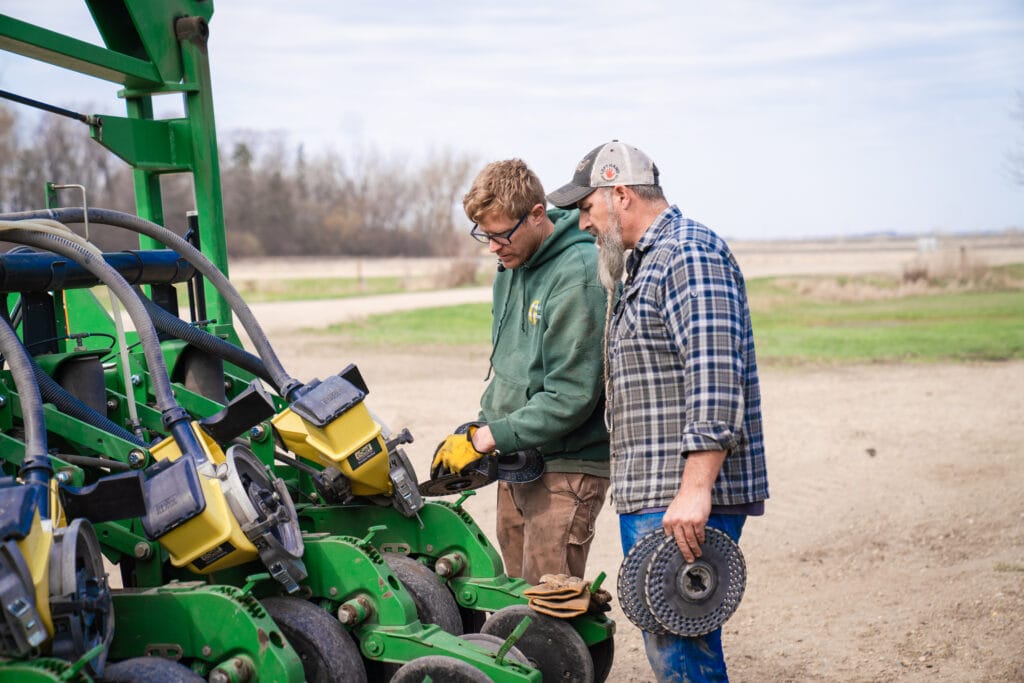


A New Generation of Farmers
Ryan represents a new generation of farmers who are reshaping agriculture. A factor of that includes the fact that many farmers today have dual careers—balancing work on the farm with another career. According to a national poll done by the USDA, a large portion of farmers, about 40%, are working 200 days or more off the farm. This indicates that there are many farmers, like Ryan, who are dual-career. Meaning that’s less time dedicated to the farm—so how do they do it? Tech, and not just the newest, high-dollar equipment either. Having the ability to digitally manage a farm’s operations from anywhere is huge.
“It’s really nice to have that stuff at my fingertips, it’d be a pain in the butt if not. Just Saturday morning I was selling silage, executing this contract, on my phone. If you had do that during working hours, even 5-10 years ago, that would make it a lot more challenging. And, if you didn’t have good technology like that, it would also make it really difficult,” Ryan said.
While modern farming tools have made it easier to manage those multiple roles, Ryan realizes that farming remains a tough industry and he credits his problemsolving mindset, developed through both his tech career and his time on the farm, as essential to his success.
“One of the things I learned when I was young is a skill that is just as important with farming as it is with entrepreneurship. On the farm, there’s always, inevitably, some kind of problem. It could be anything, something goes wrong, like equipment breaks, something doesn’t fit right, whatever it was. On the farm, we never instantaneously solved everything by just running to town and getting new parts or calling out the maintenance. But, whatever it is, we solved it ourselves, so I learned this creative skill set for problemsolving,” Ryan said. “We couldn’t just maximize resources, so when it came to starting a company, I knew I didn’t have infinite resources. I looked at what I had and asked, ‘How am I going to solve the problem with exactly what I have?’ And just do it. So I ended up with this reinforced, creative problem-solving skill over many years.”
Ryan also emphasizes the importance of community and mentorship in farming. When he took over the farm, he relied heavily on advice and help from his neighbors and fellow farmers
“That first year after dad got sick, that year we had a lot of help from the neighbors. You know, ag is just good for that type of thing. They were just wonderful, wonderful humans and we got a lot of help that year,” Ryan said
Now, Ryan just completed his first harvest season in 2024 with the farm under his name. While he could rely on family, friends, and neighbors like he did the previous year, he took ownership and found different ways to manage the different aspects of farming as well as his time physically doing hands-on work.
“There’s a bunch of core activities that you do inside of a farm. You gotta market and sell your grain. You gotta do your agronomy. You gotta do your operations. You gotta be mechanics—I end up doing a lot of mechanic work, believe it or not. I end up having a system of people, like an agronomist, a grain marketer, and some seasonal help out.”
Ryan built a team, relied on his background of growing up on the farm, and traveled the hour-fifteen trip many, many times to not only make it through the season but to do it well. Even with his preparation and experts on his side, Ryan still found himself feeling like he needed to talk decisions through with someone.

“It was kind of a life lesson—you might look at these things and know that some of the stuff is happening, but when you’re accountable for the decision, then you go back and second guess yourself,” he said. “And it’s just silly things, like, how deep should I plant the corn? Two inches, two and a half inches? Where’s the moisture line?”
Ryan knew what his father did, but he now found himself in the position to ask, “Why?”
His questioning lead Ryan to hours of research on different variables and methods and ways of doing something because he knows the many different data points that go into making a simple decision like the depth to plant a seed. It was different than just seeing his dad plant crops.
“When it’s your turn, you’re like, ‘Now I really want to get this right and not screw it up.'” he said. “They do find in agriculture that you can do everything right, and Mother Nature will still kick your ass, and you can do everything wrong, and Mother Nature will still forgive you. So, you just do the best you can.”

Looking Ahead
As Ryan continues to grow both Bushel and his family farm, he is focused on sustainability—both financial and environmental. He’s beginning to explore options like organic farming and strip-till practices to improve soil health and preserve the land for future generations—something his dad had talked about in the past
There are a few matter-of-fact reasons why Ryan is doing what he is, and some sentimental ones too.
“Financial sustainability is important. I do take pride in growing food and I want to do that better. I know it sounds silly, but if you’re going to do something, you might as well do it and improve upon it. For me that’s everything from managing topsoil and, though we haven’t done it yet, Dad and I always talked about strip-tilling and doing some organic crops,” Ryan said. “I also think part of farming is just to enjoy it. When my time on Earth concludes, I don’t know if the farm will conclude at that time—I don’t know that. I can’t speak to the future but… I think there’s no more important time than now to just enjoy it and do the right thing. And, make sure it’s financially sustainable, as much as it is environmentally sustainable.”
When asked about his favorite part of farming, Ryan’s answer is simple: time in the tractor cab.
“Sometimes you got a lot of stuff going on, like monitors and stuff and you’re trying not to screw it up, and you’re thinking about the logistics of it… Finally, when you get it all figured out, it all settles in and you’re in kind of a flow state. The tractor cab is probably my favorite, specifically, in the combine, and more specifically, in the combine cab at night.”
Learn more about Bushel at bushelpowered.com and follow along on Ryan’s journey on his LinkedIn!
Linkedin | in/ryanraguse
Instagram | @bushelpowered
Youtube | @bushelpowered
Linkedin | /company/bushelpowered
Facebook | /getbushel
Twitter | @bushelpowered

