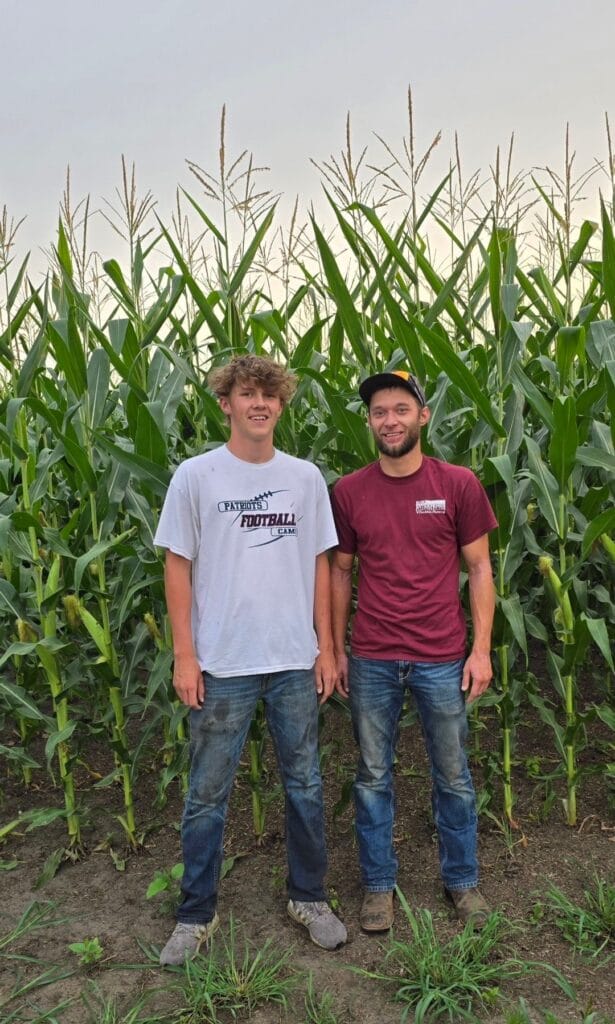
For Logan Rayner, farming has always been the end game—it’s been a lifelong endurance, ingrained in him from a young age. Growing up on his family’s farm near Finley, ND, Logan’s childhood was filled with adventures that shaped his love for agriculture. Whether it was playing with toy tractors in the living room or tagging along with his dad and farm employees in the fields, Logan was always eager to learn and be part of the operation.
“Once I was old enough to go out on the farm, I’d go ride with all of the employees— they would take me and my dad would always have me on a tractor—I just fell in love with it,” Logan said.
His connection to the farm continued through high school and college. Even while studying ag business at the University of Minnesota Crookston, Logan never strayed far from his roots—literally. Crookston’s proximity to the farm allowed him to return home every weekend, so he stayed involved in day-to-day operations while getting his education
“I chose Crookston because they have a really good farm program, a lot of known teachers, and it was probably the strongest smaller school program,” Logan said. “And, it was only about an hour and 10 to the college, so I drove back every weekend to work back on the farm.”
The University of Minnesota Crookston has great hands-on agricultural programs that prepare students for careers in agribusiness, agronomy, and agricultural education. They focus on technology, management, and practical experience— learn more here!
Now, at 23, Logan graduated college in the fall of 2024 and has returned to the farm full-time, ready to apply what he’s learned and continue building upon his family’s legacy. With 1,000 acres of his own to manage this year, he’s excited to take on new challenges and responsibilities while still collaborating with his dad and their trusted crew.
Learning Through Experience
Logan’s journey into a leadership role on the farm wasn’t a sudden transition, but rather, it was years in the making. He gradually took on more responsibilities, learning the ins and outs of farm management from his father, who allowed him to make decisions and take ownership of various aspects of the operation.
In the past few years, Logan has stepped up to manage the entire health side of the farm—overseeing equipment maintenance, planning repairs, and ensuring that operations run smoothly year-round. His father’s mentorship has been instrumental in this transition, giving him guidance while also stepping back to allow Logan to develop his own management style
“At the beginning of the day, he goes off to meetings and I go off to meetings…,” he said. “We have a list written down of what needs to be done, I usually take care of that. My dad stepped back a lot because it’s really hard having two bosses.”
His role has evolved beyond fieldwork, shifting more toward administrative and logistical planning. And while he enjoys the challenge, Logan admits that he sometimes misses spending long hours in the tractor.
“The best time I like to go and sit in a tractor is at night when nobody else is there. No one is around, I can be there as late as I want, and I don’t get any phone calls,” Logan said.
Expanding Opportunities with Drain Tiling
In addition to his farming responsibilities, Logan has found a unique way to diversify and expand his income through drain tiling—a business that started as a small side project and has quickly gained momentum.
Drain tiling is a water management practice that removes excess moisture from fields, improving soil conditions and ultimately increasing yields. This process involves installing a network of perforated pipes beneath the soil’s surface, which helps to channel water away from saturated areas and prevent standing water from damaging crops. Proper drainage allows for better root development, improved field accessibility, and greater overall efficiency in farming operations.
Logan’s drain tiling journey began modestly. His father initially purchased a tile plow to manage drainage on their own land— which Logan used, but soon, word spread among neighbors who were interested in having similar work done on their fields. Seeing the opportunity, Logan stepped up and created an entire side operation, refining his skills and expanding the service to surrounding farms.
Logan and his family, including his younger brother who is still in high school but works with Logan on the farm.
“The last couple of summers, I’ve done just a little bit for a couple of small projects for some neighbors, and everybody seems to like it,” Logan said. “I do it when I have extra time, that’s why I tell everybody I’m still a farmer first, but I’ll help you guys out.”
Last fall marked his first major project, and the response was overwhelmingly positive. With a team of workers to help with the labor, Logan has found himself balancing both farming and tiling, but he likes it, plus has the equipment for it.
“It’s all manual. A lot of manual labor getting down in the hole and connecting pipe—and that’s where I have the advantage. We have a lot of younger kids working for us and they want the extra hours, so we all come together and get it done,” he said.
A typical tiling job involves careful planning and precise execution. Logan starts by assessing the field’s drainage needs, mapping out tile placement, and determining the best depth and spacing for optimal water removal. From there, they install the drainage pipes, ensuring proper connections and placement. It’s physically demanding work, but Logan sees it as a valuable investment for both his farm and others in the community.
As he continues to build the business, Logan remains committed to prioritizing his farming responsibilities while taking on tiling projects when time allows. His long-term goal is to strike the right balance between the two, maximizing both operations without sacrificing quality.
“It’s a farming community,” Logan said. “Everybody works somehow with a farmer. I mean, everybody gets it.” – Logan Rayner
Innovation
Logan is always looking for ways to innovate and improve efficiency. He has played a key role in bringing that innovation into their operation, particularly with test plots.
Each year, he partners with agronomists and seed suppliers to experiment with different seed varieties, planting methods, and soil treatments. These test plots provide valuable insights that help the farm make informed decisions for future seasons.
“We have test plots in fields all year long. We go through Hefty Seed Company out of Finley, and they’re really good to work with. We’re doing stuff for Hefty, we’re doing stuff for ourselves, with different seed varieties,” Logan said. “If you’re not doing test trials, you’re not trying to learn.”
The Future of Agriculture
As he looks ahead, Logan sees both the challenges and opportunities that come with being a young farmer in today’s industry. The rise of autonomous equipment, fluctuating input costs, and the growing demand for sustainable practices are all factors he’s keeping a close eye on.
“[The future], it’s gonna be autonomous. We’re so close to it. It’s gonna come faster than we think. The price tag on it—nobody’s gonna want to pay, but at some point, we’re gonna have to pay it,” he said.
Despite these challenges, Logan remains optimistic about the future— just as most next-generation farmers feel. He credits the strong support system within the farming community and the willingness of farmers to adapt and innovate as key drivers of success.
The Power of Community
For Logan, farming is about the work as much as it is about being part of a larger agricultural community.
That sense of connection started early for Logan, as his father, a wellknown figure in the local ag industry and former president of the North Dakota Corn Council, introduced him to countless farmers, agronomists, and industry leaders. Whether it was attending meetings, trade shows, or community events, Logan was always by his dad’s side, listening and even building relationships with people who had been farming long before him.
“I started meeting people in high school. He took me anywhere, I mean, everywhere he went. I would tag along and go to meetings and get to know people,” Logan said.
Being part of such a strong network has been invaluable as Logan transitions into a leadership role on the farm. He knows that having a reliable community to lean on makes all the difference when challenges arise.
“It’s a farming community,” Logan said. “Everybody works somehow with a farmer. I mean, everybody gets it.”
That same sense of camaraderie extends to the team that Logan works with daily. Some employees have been with the farm for years while other workers bring fresh energy to the operation. Logan has even brought in students who want hands-on experience, giving them the same opportunities he once had as a kid riding along in the tractor. In farming, relationships matter just as much as the work itself.
“Everything you do is communication and knowing people,” Logan said, “It’s not about what you know, it’s who you know, right?”
Logan and his younger brother as young kids.
“If you’re not doing test trials, you’re not trying to learn.” – Logan Rayner
Looking Ahead
With his first full year of independent farming on the horizon, Logan is eager to put his skills and knowledge to the test. Whether he’s in the fields, managing his drain tiling business, or experimenting with new technologies, his passion for agriculture continues to fuel his drive to succeed.
Logan is ready to be all in as the next-generation farmer working on his family’s farm.