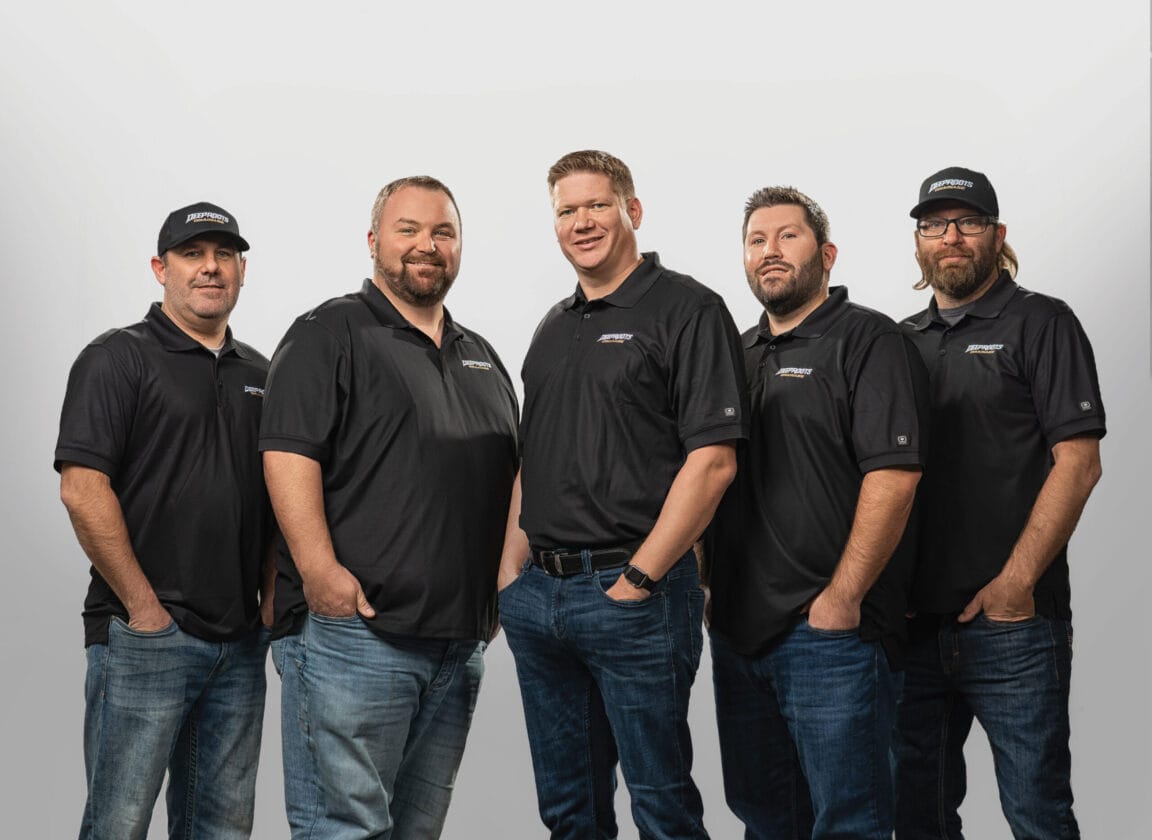
(Left To Right) Dustin , Core Y Ha Ag , Le Vi Otis, C Olin Ander Son, and Kyle Magnus
Deep Roots Drainige
For generations, farmers have learned to work around water.
They know the low spots that stay wet too long. They know the fields that are always the last to plant. They know the acres that look good from the road but struggle year after year because the soil never quite dries out, the roots never get enough oxygen, or saline spots keep creeping farther across the field.
Deep Roots Drainage was built to solve those problems.
The North Dakota-based company is new by name, but not new to the work. Its team brings over 60 years of combined experience in agricultural drainage, surveying, design, installation, sales, operations, and water management. For many farmers, the faces behind Deep Roots Drainage will already be familiar
“We’re the same handshake,” Levi Otis said. “The same friend. The same partner in your water management solutions.”
This is a group of experienced drainage professionals taking the next step, building a company around the values they believe matter most—straight answers, quality work, long-term relationships, and doing right by both customers and employees.
Drain tile is not new technology. Versions of subsurface drainage have been used for centuries across the world. But in North Dakota and northwest Minnesota, adoption is still relatively young compared to states like Iowa, Illinois, and other parts of the Midwest where tiling has been common for generations.
Many local producers are still asking, “Is it worth the investment?”
For the Deep Roots team, the answer depends on the field—but the opportunity is often clear.
Wet fields cost money in ways that are easy to overlook until the season is already slipping away. Saturated soils can delay planting, reduce root development, cool the soil, create drown-out areas, and make it harder to get equipment across the field when timing matters most. In a region with a short growing season, a few lost days can make a major difference.
Then there is salinity.
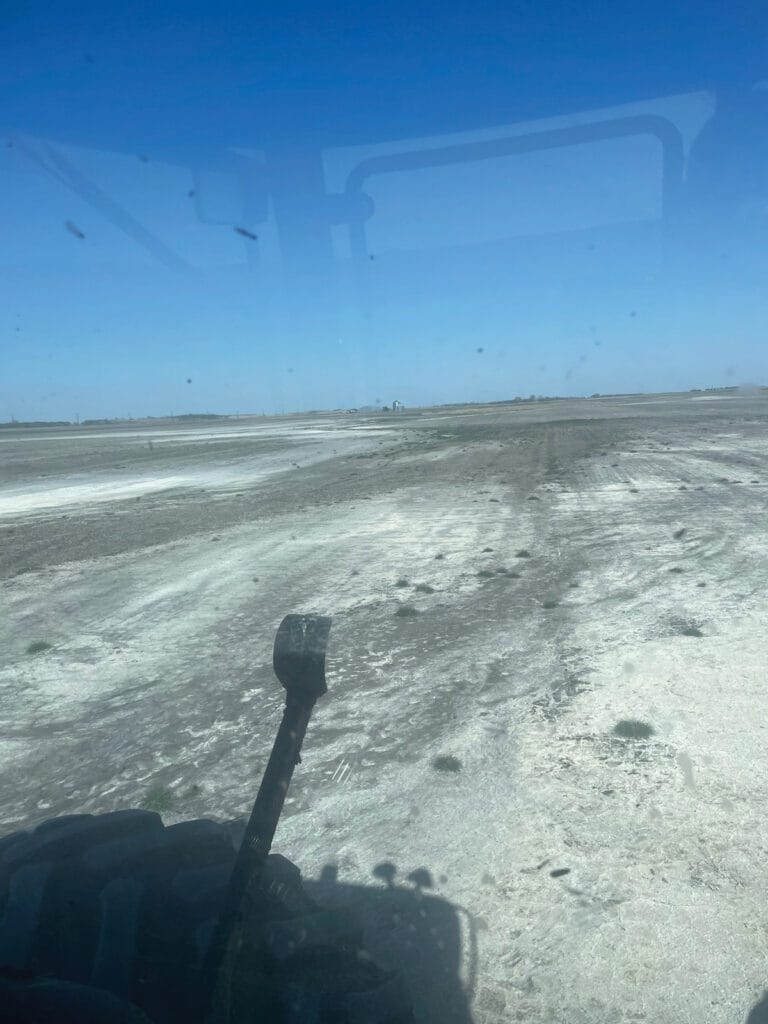
Across North Dakota, farmers have watched white, crusted patches spread across fields that once produced. Those saline areas form when excess water pushes salts toward the surface. As the water table rises, salts move up with it, and over time, productive ground can become difficult—or nearly impossible—to grow on.
Drain tile helps by lowering the water table and by moving excess water out of the soil profile. Instead of sitting on the surface or pushing salts upward, water can filter through the ground and exit through a properly designed system.
The result is a drier field and a healthier growing environment.
To be clear, tile does not remove all the water from the soil. It removes the water that the soil does not need. Think of a flowerpot with drain holes; the soil stays moist, but the excess water has somewhere to go. That balance matters because plant roots need both water and oxygen.
Tile Drainage Has Been Around Longer Than You Think
Tile drainage may feel modern, but farmers have been trying to move excess water off their land for thousands of years. Buried clay drainage pipe has been found on the island of Crete dating back to 5,000 B.C. Ancient farmers in Egypt, Babylonia, and Rome also used drainage systems to make wet ground more productive.
For some operations, the return can show up quickly. In wet years, tile can protect a crop from major loss. In dry years, tiled ground can still benefit from earlier access, warmer soils, stronger root systems, and better field conditions. According to NDSU’s frequently asked questions, drain tile ROI returns 12-15% on average.
Deep Roots generally talks about drain tile as a long-term investment, often with a seven-year average payback. But in the right year, on the right field, the impact can be immediate.
A properly installed drain tile system can help protect your investment against rain events resulting in high yields and better soil conditions for crops.
Still, the company knows cost is the biggest reason some producers hesitate. Unlike a piece of equipment, tile goes in the ground and stays there. That makes trust essential.
Drain tiling can help prevent saline disasters like this!
What Deep Roots Drainage Offers
Drain Tile Systems Custom drainage systems designed to manage water table levels, reduce erosion, reclaim wet acres, and improve yield potential. Services include targeted drainage runs, full pattern tiling, GPS-guided installation, custom spacing based on soil type, professionally designed tile plans, lift stations, and control structures.
Water Conveyance Because a tile system is only as good as its outlet, Deep Roots Drainage also helps improve how water moves off the field. Services include cleaning existing ditches, permitted ditch enhancement, ditch reconstruction, snagging, clearing, and GPS-integrated grading work.
Land Clearing & Grubbing Deep Roots helps turn nonproductive ground back into usable farmland through tree and shelterbelt removal, unwanted vegetation clearing, and rock pile burial or removal.
Deep Roots Drainage builds each system around the field itself. The process begins with surveying the land and identifying problem areas using topography, soil types, water movement, and customer input. From there, the team designs a custom system based on field slope, drainage needs, outlet options, and long-term goals.
Installation is done with modern tile plows and RTK GPS grade control, allowing the team to maintain precise depths and grades across complex terrain. The company handles everything from targeted drainage runs to full pattern tile systems, as well as lift stations, control structures, gravity outlets, ditch enhancement, water conveyance, land clearing, grubbing, shelterbelt removal, vegetation clearing, and rock pile removal.
Just as important, Deep Roots understands the regulatory side of drainage. Between permitting, NRCS rules, U.S. Fish and Wildlife easements, drainage law, and local water management requirements, some producers may assume a project is impossible before they ever ask.
Deep Roots wants to be a partner in that process, too.
Deep Roots backs its work with a craftsmanship warranty and uses heavy-duty corrugated pipe, proper fittings, and proven installation practices.
For farmers who have lived with problem ground for too long, the first step is simply to take a closer look.
Because every season is costing something.
And with the right drainage plan, those acres may be capable of far more than they are producing today.