USDA’s National Proving Grounds Network Aims To Take The Guesswork Out Of Agtech
351 Views
For generations, American agriculture has moved forward on the strength of innovation.
Whether it was the advent of hybrid seed, crop protection, precision equipment, biotechnology, or digital tools, each era has brought new promises to the farm gate, and each has forced producers to ask: Will this actually work for me?
That question has become more urgent as agriculture enters a new wave of technology built around automation, artificial intelligence, robotics, sensors, digital scouting, precision application, biologicals, and data-driven decision-making.
The opportunity is enormous, but so is the uncertainty.
That is why the U.S. Department of Agriculture has announced the creation of the USDA National Proving Grounds Network for AgTech, or NPGAg, a nationwide initiative designed to test and validate agricultural technologies under realworld U.S. farming and ranching conditions.
The ultimate goal is to give farmers and ranchers trusted, objective, practical information before they make major technology investments.
For Dr. Scott Hutchins, USDA Deputy Under Secretary for Research, Education, and Economics & USDA Chief Scientist, the initiative is about helping producers sort through a rapidly changing marketplace and identify the tools that can truly improve profitability.
“What I’ve been looking for since I’ve been in public service is, what role does the public sector play? What role does USDA specifically play to help the acceleration of these really exciting technologies get into the hands of our farmers and ranchers?” Hutchins said.
His answer is the National Proving Grounds Network
The initiative will be led by USDA’s Agricultural Research Service in coordination with other USDA research agencies. Grand Farm, the North Dakotaheadquartered AgTech ecosystem and innovation testbed, will serve as the national program manager. Land-grant universities across the country will serve as primary research and testing partners.
Together, the network is intended to create a trusted, transparent way to evaluate new technology before producers are asked to bet real money on it.
About Dr. Scott Hutchins
Dr. Scott Hutchins serves as Under Secretary for the U.S. Department of Agriculture’s Research, Education, and Economics & USDA Chief Scientist mission area, where he helps guide USDA’s work in agricultural research, innovation, education, and economic analysis. Before entering public service, Hutchins spent more than three decades in the private sector, giving him extensive experience with the discovery, development, and launch of agricultural technologies. In his role at USDA, he is focused on helping accelerate practical innovations that improve farm and ranch profitability, strengthen U.S. agricultural competitiveness, and give producers better tools for making informed decisions. Hutchins has been a leading voice behind the USDA National Proving Grounds Network for AgTech, emphasizing the need for objective, transparent, real-world data that helps farmers and ranchers adopt technologies that truly add value.
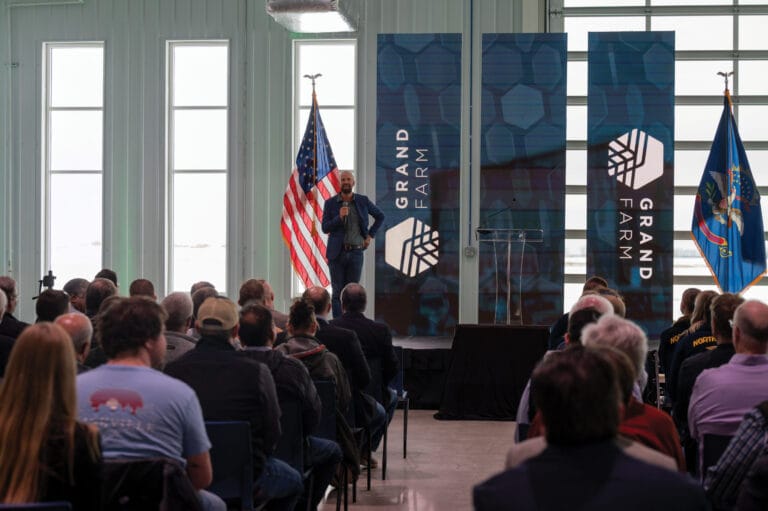
Grand Farm CEO & founder Greg Tehven at the National Proving Grounds Network announcement
Why This Especially Matters Now
Farmers and ranchers are no strangers to new technology. But Hutchins said the current wave of AgTech is different from many of the major innovations that came before it.
In the past, many agricultural technologies—such as genetically modified crops, herbicides, insecticides, and fungicides—went through years of regulated testing and demonstration before they were commercially available. By the time a farmer could buy them, they often had years of extension trials, demonstration plots, and field data to rely on.
“They know by the time they get to the point of purchase what they do,” Hutchins said. “They know how they fit on their farm. They know all of those things. So it’s not a very risky purchase.”
Digital agriculture does not always work that way
Today, a startup may bring a new artificial intelligence tool, sensor platform, autonomous machine, scouting system, or decision-support product to market far faster than traditional agricultural technologies. That speed can be good. It can also leave farmers without enough independent data to know whether a product will perform under their conditions.
“In the case of AgTech, and in the case of this next generation of digital ag, it’s a Wild West in terms of innovation, in terms of startups and the rest of it,” Hutchins said. “And I say that in a good way.”
The challenge, he said, is making sure U.S. farmers and ranchers can adopt the best technologies early without being forced to carry all the risk themselves.
“If we want our U.S. farmers to be the first to adopt and get the most benefit, we need to find a way to give them confidence that these technologies are actually going to provide the value that’s being proposed,” Hutchins said.
About The National Proving Grounds Network
The USDA National Proving Grounds Network for AgTech, or NPG-Ag, is a new national initiative designed to test agricultural technologies under real-world farming and ranching conditions. The network will evaluate tools such as digital scouting systems, robotics, automation, AI-driven platforms, precision application technologies, livestock monitoring tools, and other emerging innovations. The goal is to provide farmers and ranchers with objective, transparent performance data so they can make better technology investment decisions. USDA’s Agricultural Research Service will lead the effort, with Grand Farm serving as the national program manager and land-grant universities acting as research and testing partners.
About Grand Farm
Grand Farm is a North Dakota-based AgTech ecosystem and innovation testbed that brings together growers, startups, corporations, researchers, educators, government partners, and investors to solve real-world challenges in agriculture through applied technology. Headquartered in the Fargo area with an Innovation Campus near Wheatland, Grand Farm supports field trials, technology testing, industry collaboration, and events that connect agriculture with emerging tools such as automation, artificial intelligence, robotics, sensors, and precision agriculture. As the national program manager for USDA’s National Proving Grounds Network for AgTech, Grand Farm will help coordinate technology companies, USDA’s Agricultural Research Service, and land-grant universities to evaluate new innovations under real farming and ranching conditions.
At the end of Bridge the day, our priority is the same: to get proven, valuable technologies into the hands of our farmers and ranchers as quickly as possible so they can boost profitability.” – Dr. Scott Hutchins, USDA Deputy Under Secretary For Research, Education, And Economics
A Pubic Private Bridge
The Proving Grounds concept itself is not entirely new.
Agriculture has long relied on field trials, extension research, demonstration plots, university testing, and equipment evaluation. Hutchins pointed to examples like tractor testing at the University of Nebraska and the long history of seed, crop protection, and extension trials.
What is new, he said, is the national coordination, the USDA’s leadership role, and the intentional focus on emerging AgTech.
“I’m not here to say that the proving concept itself is completely novel,” Hutchins said. “But I think what is novel is the application that we have and how we’re building a true public-private partnership in a way that is flexible and continuous.”
The network is not designed to test one type of technology, one crop, or one production system. Instead, it will be built around categories of need like weed control, digital scouting, precision fertilization, automated harvesting, livestock monitoring, food safety inspection, geofencing, and other technologies that could improve efficiency and profitability
The network will also support both commercial and precommercial technologies.
For products already on the market, the value is independent performance data.
For pre-commercial products, the network could help innovators refine technologies before they reach farmers. Hutchins said many startup founders may have strong technical expertise but limited experience with the realities of agricultural production. By connecting those companies with land-grant universities, USDA scientists, and field-testing environments, the network can help shape tools around actual producer needs.
“At the end of the day, our priority is the same: to get proven, valuable technologies into the hands of our farmers and ranchers as quickly as possible so they can boost profitability,” Hutchins said.
North Dakota’s Role
Grand Farm will serve as the project management office for the national initiative, which will include many moving parts like technology companies, USDA agencies, ARS scientists, land-grant universities, crop-specific protocols, trial locations, data reporting, confidentiality agreements, and producer-facing communication.
Hutchins said USDA expects pilot projects to begin in 2026 with a limited number of concepts and sites. Those early pilots will help USDA and its partners learn what works, what needs adjustment, and how to scale the effort.
“We will have some pilot projects with a very limited number of concepts and a very limited number of sites,” Hutchins said. “For us to kind of fine-tune how we’ll do it, what we need to know, what we don’t know.”
Those first pilots are expected to be based in North Dakota and Georgia, with work spanning row crops and specialty crops.
From there, USDA plans to expand in 2027 and continue scaling the network over time.
How large could it become?
Hutchins said that depends on the technology concept being evaluated, the crops or markets involved, and the locations where testing is needed.
For example, if the network evaluates digital scouting in cotton, testing would need to happen in cotton-producing regions with land-grant partners who understand that crop and production system. If the focus is on automated apple harvesting, the network would involve a completely different crop, geography, and set of research partners.
“That’s why we call it a network,” Hutchins said. “The network’s going to be fluid.”
What Technologies Could Be Tested?
The National Proving Grounds Network is beginning with AgTech and digital agriculture, but the potential categories are broad.
Hutchins mentioned several examples, including:
Digital scouting for insects, diseases, and crop conditions.
On-the-fly precision fertilization.
Automated harvesting in specialty crops.
Automated processing and food safety inspection.
Livestock health assessment tools.
Remote geofencing.
And other technologies that could improve efficiency, reduce labor needs, lower input costs, or support better management decisions.
The network is not meant to be limited to a fixed list.
“We’re not going to limit that and say we’re only doing five,” Hutchins said. “We’re going to try to identify the ones that do have the biggest impact.”
How Products Will Be Selected
One of the details still being developed is how specific technologies will be selected for testing.
Hutchins said Grand Farm will help manage the process with USDA. Companies with relevant technologies will likely go through an applicationstyle process to determine whether their product fits the concept being tested.
The goal is not to force a technology into the wrong trial. If a tool is not designed for a certain application, testing it under that category would not help the company, the researchers, or the producers who eventually read the results.
“We don’t want you to put your technology in something it’s not really set up to do,” Hutchins said.
Once USDA and its partners identify a technology category and participating products, land-grant universities will help execute trials in the appropriate regions.
The details are still being worked through, including how many technologies can be evaluated in a single trial and how testing capacity will be managed if interest is high.
“We hope we get to that,” Hutchins said. “We hope that’d be a good problem to have.”
The Importance of Protocols
For the network to be useful, testing must be consistent, transparent, and relevant to real farm and ranch decisions.
That means protocols matter
USDA and its partners are working through how to design testing methods that are scientifically sound while still answering the questions producers actually care about.
“We want to make sure the protocol is one that really, truly reflects what the farmers and ranchers need,” Hutchins said.
A weed control technology, for example, cannot simply be judged in broad terms. Producers need to know what level of performance was achieved, under what conditions, and how consistently. Was it 95% control? Was that level of control achieved 95% of the time? How should that performance be interpreted?
Those are the kinds of questions USDA will need to define before results can be communicated in a way that producers can use.
Hutchins emphasized that USDA will not be making product recommendations. Instead, the role of USDA and the landgrant partners will be to provide objective, repeatable, transparent data.
“We will not be making recommendations,” Hutchins said. “The USDA and land-grants should never make recommendations on products. But what we can do is certainly provide the objective, repeatable, and transparent data so that farmers and ranchers can make decisions with good knowledge.”
Technologies That Could Be Tested
The National Proving Grounds Network could eventually evaluate a wide range of technologies, including:
Digital crop scouting tools • AI-driven decision platforms
For Hutchins, the Proving Grounds Network ties directly to USDA’s broader mission around farm and ranch profitability.
He said the top priority for USDA’s Research, Education, and Economics mission area is helping farms and ranches become more profitable. Once operations are profitable, he said, other goals—such as conservation and long-term resilience—become more achievable.
“If the farms and ranches are more profitable, then all of the other things we want farms and ranches to do, whether it’s conservation or the other things, will come much more naturally,” Hutchins said.
Most farmers cannot set the price they receive. They operate in markets shaped by commodity prices, weather, global competition, input costs, labor availability, and policy conditions. But they can manage costs. They can improve efficiency. They can make better-timed decisions. They can adopt tools that help them produce more effectively.
“Most of agriculture is very dependent on a cost position,” Hutchins said. “They can’t set the price that they sell for in most cases, but they can manage their inputs, and they can manage the efficiency of how they produce it.”
That is where technology can matter most.
What Farmers and Ranchers Can Do Now
For farmers and ranchers, the immediate role is not necessarily to host trials or submit applications. Some trials may eventually take place on production farmland, but the early network will be built through USDA, Grand Farm, ARS, land-grant universities, and participating technology companies.
For producers, Hutchins said the first step is to pay attention.
Follow the development of the network. Watch for results. Look for opportunities to learn which tools are being tested and how those tools perform. Most importantly, think carefully about where technology could create value in your own operation.
“We want them to lean in on the need and the opportunity for the technology,” Hutchins said. “It’s all about trying to get them to adopt the things that make sense and add value.”
Only the Beginning
Although the initial focus is AgTech and digital agriculture, Hutchins sees the model as much broader.
One future application could be soil biologicals. Like digital tools, biological products are a fast-growing area with significant claims, inconsistent results, and a real need for objective testing.
“There’s a lot of those out there,” Hutchins said. “Some of them seem to have some pretty good promise. Some of them don’t seem to have a lot of promise. But there’s no way for farmers today to really have any kind of objective, consistent data with a reliable and an objective protocol to really know which ones would make sense for them.”
Whether biologicals become the second generation of the Proving Grounds model remains to be seen. But Hutchins said the concept itself could apply to many categories of agricultural innovation over time.
“The model is, I think, timeless,” he said.
As new technologies emerge, agriculture will keep facing the same question: How do producers know what works?
USDA’s answer is to build a national network capable of testing those tools in the field, reporting results transparently, and helping farmers and ranchers make better decisions.
The details are still being developed. The early pilots are still ahead. The network will have to prove itself, just like the technologies it evaluates.
But Hutchins said the response so far from land-grant universities and agricultural partners has been strongly positive.
“Every land grant I’ve talked to and every group I’ve talked with is incredibly supportive and sees nothing but growth and potential value from doing this if we do it right,” he said.