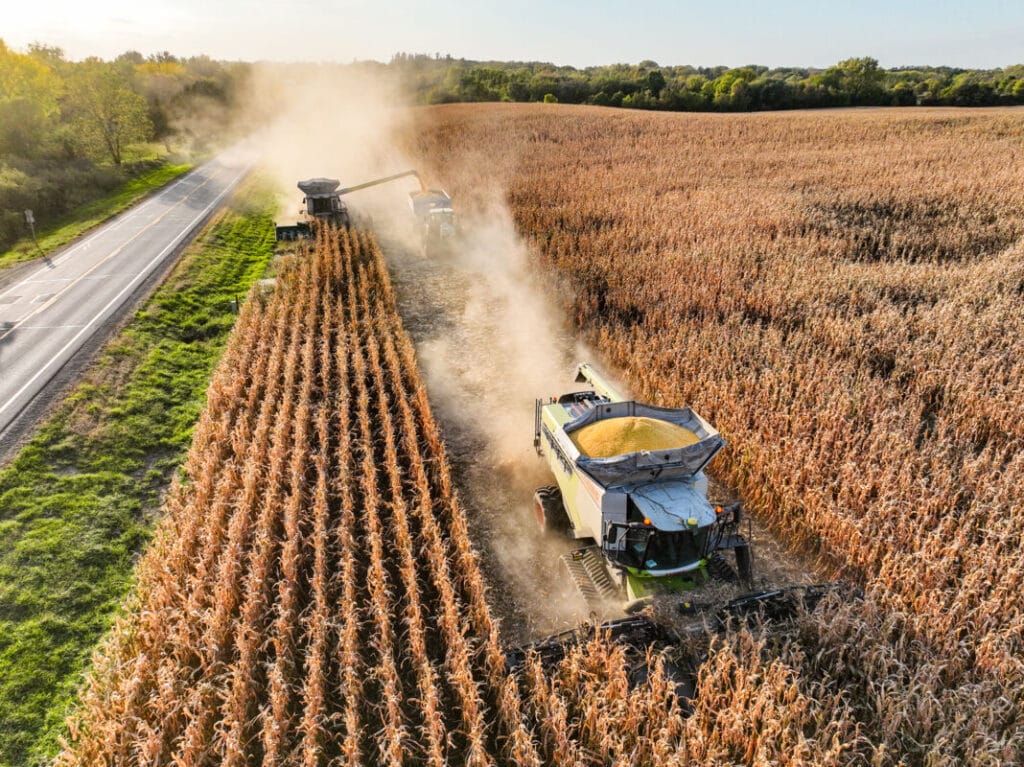
Did You Know? Grand Farm’s new Innovation Campus is strategically placed just south of Casselton, ND, and CHS also marks its presence with a facility in Casselton—making the rural town just 20 miles outside of Fargo-Moorhead a hotbed for agricultural advancements and collaborations.
Our region is infamously the meeting point of tradition and innovation, where timeless methods unite with cutting-edge solutions to progress and better the agriculture landscape. And most recently, the crux of it is at the crossroads of CHS and the Grand Farm Innovation Campus. Let’s explore how CHS, a powerhouse cooperative with deep roots in providing agriculture and energy products and services, is collaborating with Grand Farm to push the boundaries of farming technology. Together, they will foster developments that aim to revolutionize local, national, and global agricultural sectors. Learn how these entities will intertwine their expertise and resources to cultivate a future where agriculture thrives through innovation and strategic collaboration.
Empowering Agriculture
CHS is Pioneering the Cooperative Model
Owned by U.S. farmers and agricultural cooperatives, CHS harnesses the collective strength of its members to foster a robust agricultural network that spans the entire globe. With a core purpose centered on empowering agriculture, CHS delivers an extensive range of products and services across the grains, foods, and energy sectors to support the vast ecosystem of the global agricultural community.
Their commitment to providing value to owners is pivotal in ensuring that agricultural stakeholders—from family farms to large agribusinesses—can thrive within the quickly evolving landscape of modern ag.
The cooperative’s approach creates sustainable value for its members and the communities they serve. This strategy encompasses everything from improving crop yields and providing access to global markets to fostering economic stability in rural areas. Through initiatives like these, CHS continues to carve a path toward a more innovative and profitable agricultural future, ensuring that it remains a cornerstone in the world of agriculture for generations to come.
By seamlessly integrating cutting-edge agricultural technologies with traditional farming practices, CHS is not just responding to current demands, but is actively shaping the future of farming—sound familiar?
Strengthening Futures Together
CHS and Grand Farm’s Partnership
The company’s current impact includes significant partnerships that aim to shape the future of farming—that’s where Grand Farm comes in.
The collaboration between CHS and Grand Farm epitomizes a forward-thinking approach to agricultural innovation and technology. This partnership leverages the cooperative’s extensive resources and agricultural expertise alongside Grand Farm’s cutting-edge research facilities, technological focus, and plentiful networking opportunities.
CHS has joined forces with Grand Farm to pioneer the next wave of agricultural innovation. This partnership is centered around Grand Farm’s Innovation Campus, a hub designed to revolutionize farming through advanced technologies like autonomy, artificial intelligence, robotics, and drones. CHS contributes resources and agricultural insights, aiding in the development and testing of new technologies that promise to enhance farming efficiency and outcomes. The collaboration is a strategic move to tackle the pressing challenges in agriculture, aiming to equip farmers with next-generation tools to increase productivity and operate sustainably. Real-world applications of this collaboration include smart farming techniques that can reduce resource use and optimize crop yields.
If Grand Farm is the intersection between growers and tech companies, then Grand Farm Innovation Campus is where innovators and enterprises test, research, and connect; and that makes CHS one end of the bridge connecting solutions to those who need them, those who are making a difference in the agriculture landscape around the world.
Did you know CHS provides the products and services farmers need to feed a growing population?
Here’s a quick peek at a few of the products and services they offer.
Agronomy: Including crop nutrients, crop protection, and seeds.
Energy: Ranging from refined fuels and propane to renewable fuels and lubricants.
Grains: Handling, marketing, and processing of grains.
Foods: High-quality ingredients like oilseed products for diverse culinary needs.
Animal Nutrition: Products and services to ensure livestock are healthy and nourished. Transportation and Logistics: Expert solutions for moving goods efficiently and effectively.
CHS Hedging: Helping manage price risk in commodities.
Innovating In the Field
CHS Research and Projects at Grand Farm
CHS is exploring innovations and technology that benefit the agriculture industry in a variety of ways. In North Dakota, CHS is embarking on a pilot project to bring automated driving technology to the state. The cooperative has successfully piloted leader-follower platooning approach with trucks in other states and across 10,000 miles, whereby a human-driven lead truck is followed by a specially outfitted and wirelessly linked follower truck that is also currently staffed with a safety driver.
The pilot project aligns with the state’s investment in autonomy-related technologies and helps identify ways to use automated driving to benefit agribusinesses and the industry at large.
Executive Insight: Q&A with David Black
David Black serves as the executive vice president, enterprise transformation, and chief information officer at CHS. He is also responsible for the company’s marketing, communications, and sustainability initiatives. Before joining CHS, Black held various leadership roles at Monsanto Company, including Vice President of Information Technology. He is recognized for his transformational leadership in technology and business, and serves on several boards. David earned a bachelor’s degree in computer science from Tarkio College.
Editor Brady Drake sat down with CHS Executive Vice President, Enterprise Transformation, and Chief Information Officer David Black to explore his insights on the evolving landscape of agriculture and the partnership with Grand Farm. In this exclusive Q&A, David shares his perspective on innovation, the role of technology in agriculture, and strategic initiatives at CHS aimed at enhancing efficiency and sustainability across the industry.
Q: Why is CHS partnering with Grand Farm?
A: We have a significant presence in North Dakota—it’s an important geography for CHS and an important geography across U.S. agriculture. At CHS, we think of ourselves as innovators and technology leaders within agriculture and energy. We were introduced early on to Greg Tehven, chair of the Grand Farm board, and on day one, he talked about the idea of Grand Farm. They invited us into the conversation because they know what we do here in North Dakota.
Q: What is CHS looking for in this partnership?
A: First, we appreciate being part of an ecosystem that introduces us to other innovators and entrepreneurs. What CHS brings to the table is scale. CHS is the country’s largest farmer-owned cooperative, which means we touch a lot of acres. Entrepreneurs have great ideas around technology and innovation for agriculture, but they don’t necessarily have the ability to implement them to scale. So, when you put those two things together, a company’s ability to scale technology and these innovative ideas, that’s where the magic happens. That’s why we see CHS as a partner to Grand Farm, because it gives the ability for innovators to come together and do something. We see Grand Farm as an enabler, a place to try things, to pilot and to test. It has been open for a few seasons with side-byside, local agronomy test plots. We’re thinking about Grand Farm and North Dakota as a place to continue our pilot on automated driving technology, possibly on the test track. And, we see the Grand Farm Innovation Shop as a facility we will be able to use as an extension of our own innovation facilities.
Q: You mentioned the test track and automated driving technology. Are there any other specific areas of innovation that CHS is focused on right now?
A: When you think about innovation, there are really two areas. One is this notion of automated vehicles, like drones—we have a drone fleet that we run—that can be autonomous vehicles on the field, or that can be autonomous vehicles on the road. That’s one space of technology. The other really is analytics, generative AI, and artificial intelligence. We have a significant interest in AI and how it will come to life for farmers and others in the agriculture industry.
Did you know? CHS is the country’s largest farmer-owned cooperative. The company employs around 10,000 people globally. While the company’s impact and reach are global, the headquarters are right next door near St. Paul, MN.
Q: That has to be a pretty fast-evolving space for you guys to be in right now, right?
A: It’s an incredibly fast-evolving space. I was just speaking to a group of CEOs recently about generative AI because they were wondering, “What do we do with this?” I said, “As much as you may feel like you’re behind, the reality is, you’re probably not.” Because generative AI in terms of being commercially available, is only about a year old. It started gaining popularity last spring. It is changing rapidly. There are probably no right or wrong answers, but being part of understanding the technology and building a strategy, that’s where you need to be in terms of generative AI.
Q: What is CHS thinking about for an immediate strategy with the use of analytics and AI?
A: When you think about generative AI, there are two key components to our strategy. One is operating with integrity. There are things like protecting intellectual property that are important. We’ve done work and put policies in place to educate and to train people on [the idea that] if this thing was created with generative AI, let’s make sure that you’re representing it as being creative, generative AI and not representing as your own work. That’s one part of the strategy—making sure we have policies in place and we can operate with integrity. The second part of the strategy is the technology. Microsoft is one of our partners in generative AI; so putting in place the data structure, the data management, and then the generative AI technology with them is important.
Q: Are you building custom GPT to use with that software? Or how are you utilizing it?
A: Yes. We have prompt engineers on staff and we are doing some custom work ourselves. Certainly, a lot of this is in pilot, right? We have things as fundamental as Microsoft’s Copilot, which is deployed across a number of our users to support their productivity suite [like] Word, Excel, and PowerPoint. That would be one application. We have chat prompts available. A specific example, in our HR space, we have archived a lot of benefit information. When you call an HR specialist they have a chat prompt available where they can quickly find information to help answer calls to support employees. We also have prompt engineers who are writing custom GPT code, specifically, for challenges in our business. We look at the supply chain, we look at economic information— those things that we already have big datasets, that’s typically where we’re applying analytics.
A Century of Innovation
From its beginnings in the late 1920s, CHS has grown into a leading global agribusiness cooperative. Here’s a glance at how they’ve evolved over the decades:
1929: CHS began as North Pacific Grain Growers, initially forming with 60 local cooperatives.
1931: The formation of Cenex, originally known as Farmers Union Central Exchange.
1938: Establishment of the Farmers Union Grain Terminal Association in St. Paul, MN.
1940s: Expansion into wheat milling and the acquisition of oil refining capabilities.
1960s: CHS built a significant petroleum pipeline from Montana to North Dakota and expanded into soybean processing.
1970s: Marked by further diversification into transportation and the introduction of innovative retail services like pay-at-the-pump technology.
1980s: The merger of North Pacific Grain Growers and GTA to form Harvest States Cooperatives and the inception of Cenex convenience stores.
1990s: A decade of growth with significant acquisitions and joint ventures in grain processing and food services.
2000s: CHS adopted its current name and expanded its global operations, establishing offices and operations from Switzerland to China and Ukraine. 2010s and beyond: Continued expansion with new ventures in grain trading, agronomy, and innovative agricultural solutions.
Q: Not to get too much in the weeds, but how long have you had prompt engineers?
A: It’s brand new. Last summer we posted the first role so we have had prompt engineers in our environment [starting] fall of 2023. Even a year ago, the idea of having someone on staff as a prompt engineer was unheard of. It’s a whole new discipline.
Q: You have three different titles. Can we hear from you what you do?
A: I think about my role in three ways. One, I’m the chief information officer, so all the technology and leading the technology for the company is important [to me]. The second is the transformation officer. CHS is constantly monitoring and continuing to improve our operating model, so we can be the best company we can be. I lead all that transformation work. And the third is leading our marketing and communications efforts. Things like this conversation that we’re having today, the way our brand shows up, the way we market CHS, and our reputation.
If you think about all three of those things, they fit together. I have some additional responsibilities, such as overseeing our venture capital work and our sustainability efforts. If you think about that portfolio, it’s all about the future of the company. And that’s the way I like to think about my job. We have a lot of great people at CHS who are running the place and keeping it operationally strong, and my job is to make sure that CHS can exist for the next 100 years. A lot of that work I do is around innovation and transformation to make that possible.
I’ve been involved in agricultural technology for 30 years, and I have never seen a brighter future than I see today. Not just in terms of technology and innovation, but quite frankly, the world’s reliance on US farmers to help feed a growing population. I don’t know that there’s a more exciting place to be than agriculture.”
– CHS Executive Vice President, Enterprise Transformation, and Chief Information Officer David Black
Q: Are you really looking out that far ahead?
A: I’m not looking out 100 years, but CHS is going to be 100 years old in the next few years—so I do think about leaving a legacy for future generations, that this cooperative is going to last for another 100 years. Now, how far out do I think in terms of technology innovation? I’m thinking of the next 5 to 10 years; which in terms of technology, being able to forecast 5 years from now is really tough to do. Having said that, we make capital investments today in entrepreneurs through venture capital work, and we’re looking at 5 to 10 years before those entrepreneurs are scaled up and have something that’s commercially available.
Q: This might be too broad of a question, but we talked about how things are changing really fast and the ag space is starting to finally adopt a lot of these new technologies. ARE there any that gets you really excited about the possibilities on the immediate horizon, in the next three to five years?
A: I’ll answer your questions in two ways. I get really excited when I see things like the [Grand Farm Innovation Campus]. I see money coming in for agriculture, specifically for technology. For 30 years I’ve been in agriculture and technology, and probably in the last three to five years, I’ve seen more capital investment and more evolution of technology equipment. So, that’s really exciting.
I think a challenge for our industry, though, is that all of this technology has to be connected, and there are a lot of disconnected parts of agriculture. There’s data on the farm, and one company may have data, but they don’t share it with another. A farmer may have data that they can’t share with their neighbor. There’s this lack of connectivity and it’s going to be a real challenge for the industry. Over time, we’ll figure out that connectivity must be part of anything we do in technology, it can’t just be about the new shiny tool, it has to be about how that tool is going to connect more broadly across agriculture.
Q: One thing I always try to ask people when I interview them, David, is what message do you want to say to farmers? Is there anything that they should be thinking about?
A: I think, especially to future farmers but to farmers in general, innovation and technology, it’s real. It’s absolutely changing in agriculture—embrace the change. Not in such a way that disrupts or puts your operations at risk, but embrace the change, be part of it, and come out to places like Grand Farm to understand what’s going on in terms of new technology. See it, feel it, and touch it if you can in your own operations.
Q: In your 30 years, did you see any of this coming?
A: The short answer is probably yes. Did I see specifically where we are today? No, I don’t know that anyone could say yes. Did I see a day when, folks who were innovators and entrepreneurs would wake up and say, “Holy cow, agriculture is a massive industry. It’s got lots of challenges, but it creates a huge benefit to society. I want to be part of that.” Yes, I did see a day in which this would be an industry that people want to be part of and invest in, and just because they hadn’t grown up on a farm didn’t mean they didn’t want to be part of this industry. I think I always saw that day.
Continuing the Legacy of Cooperative Success
CHS collaborates with pioneers like Grand Farm to explore new horizons in technology and sustainability, and this partnership promises to drive innovation and deliver transformative solutions to ensure sustainable growth and a thriving agricultural sector. Together, CHS and Grand Farm are setting the stage for a future that builds on a legacy of cooperative success.