
Photos Provided by Helical Solar
A Farmer-First Approach to Solar
When James McKinion talks about the future of Helical Solar, he does not start with panels, wires, or power purchase agreements. He starts with land.
More specifically, he starts with the tension surrounding land.
Across the country, the rapid rise of AI data centers is creating an enormous appetite for power. Many of those projects are being proposed in rural, agriculture-based areas where land is available, but where residents are increasingly wary of large industrial projects that can strain water resources, add pressure to the grid, and change the character of a community.
At the same time, utility-scale solar projects often face the same kind of resistance. Farmers and rural landowners may be asked to give up productive acres for solar development, while nearby communities are left wondering what they actually gain.
McKinion believes Helical Solar can offer a different model.
“I think we can flip that model on its head,” he said.
Helical Solar is developing what McKinion describes as next-generation agrivoltaics: a dual-use solar system designed from the ground up for agriculture. Instead of forcing agriculture to adapt to traditional solar infrastructure, Helical Solar’s technology is built around the realities of working farms, ranches, feedlots, dairies, and row-crop operations.
The goal is to allow farmers and ranchers to keep doing what they already do while also generating energy from the same land.
Agriculture is not just an asset class or a parcel on a spreadsheet. It is a way of life. Asking a farmer to stop farming in order to host solar may look reasonable on a spreadsheet, but it often misses the human reality of the decision.
“You have to maintain that ability for them to keep farming what they’ve been farming or raising what they’ve been raising,” McKinion said.
That is where Helical Solar’s engineering comes in.
Engineering Solar Around the Farm
Traditional solar systems are typically designed for dense energy production, not agricultural compatibility. They can create shading “dead zones,” require grading, interfere with equipment, or sit too low to safely coexist with cattle. Helical Solar’s system is elevated, uses dual-axis tracking, and is installed with a patented helical pile foundation system rather than concrete footers.
The name Helical Solar comes from that foundation concept. The system uses a large ground screw that can be augered into the earth and later removed by reversing the rotation. For farmers, that matters. Concrete and permanent structures in a field can create long-term headaches. McKinion wanted a solution that could be installed, used, and eventually removed without leaving the land permanently altered.
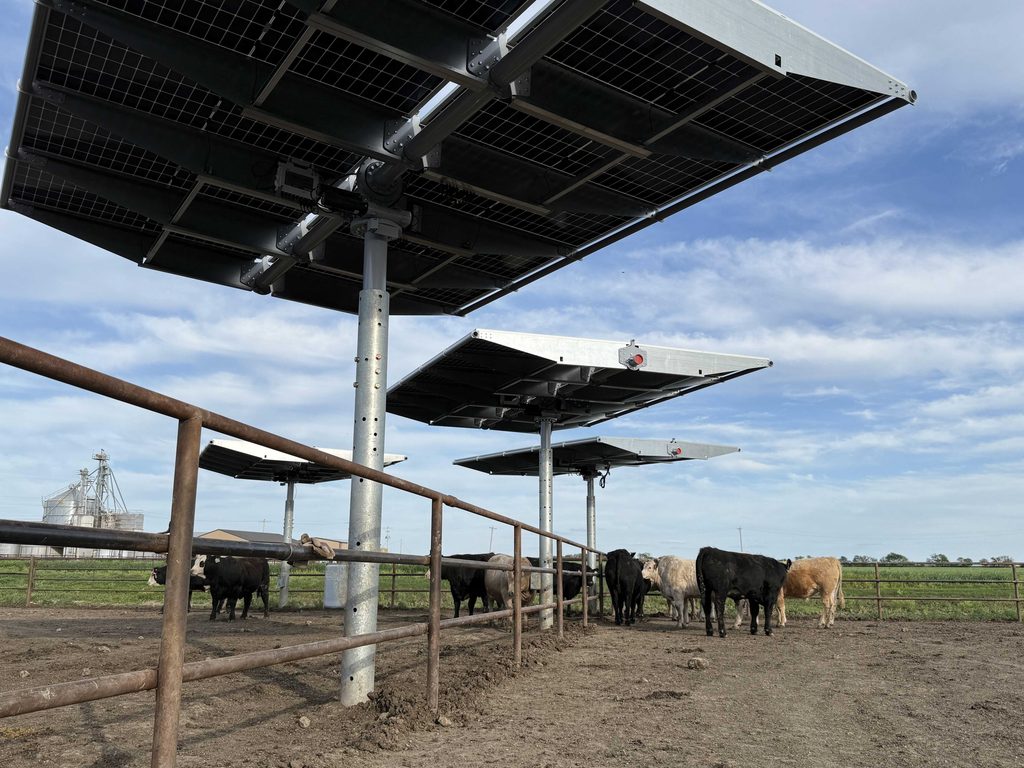
Above ground, the system looks like an elevated solar array mounted on a large steel support. The panels sit roughly 13.5 feet high when horizontal, keeping them out of reach of cattle and clear of many farming operations. The system tracks the sun throughout the day, moving about every 10 minutes.
That movement is especially important for row crops such as corn, cotton, soybeans, and wheat, which require full sun. Unlike fixed or single-axis solar systems, which can cast more persistent shade in the same areas, Helical Solar’s moving shadow behaves more like a sundial.
“Our shadow moves throughout the day,” McKinion said.
According to McKinion, shading models using a Massachusetts Department of Energy Resources analysis tool showed single-digit shading, which the company believes can result in negligible yield loss for full-sun row crops. For the system to work at scale, he said, it has to meet farmers where they are today. That means accommodating the large machinery they already own, from sprayers to seed drills, rather than asking them to downsize or redesign their entire operation around solar.
“It’s going to be a no-go to ask a farmer to swap out his large and costly ag machinery and size down,” McKinion said. “You have to meet the farmer where he’s at today.”
The livestock application may be just as important.
Solving Heat Stress in Feedlots and Dairies
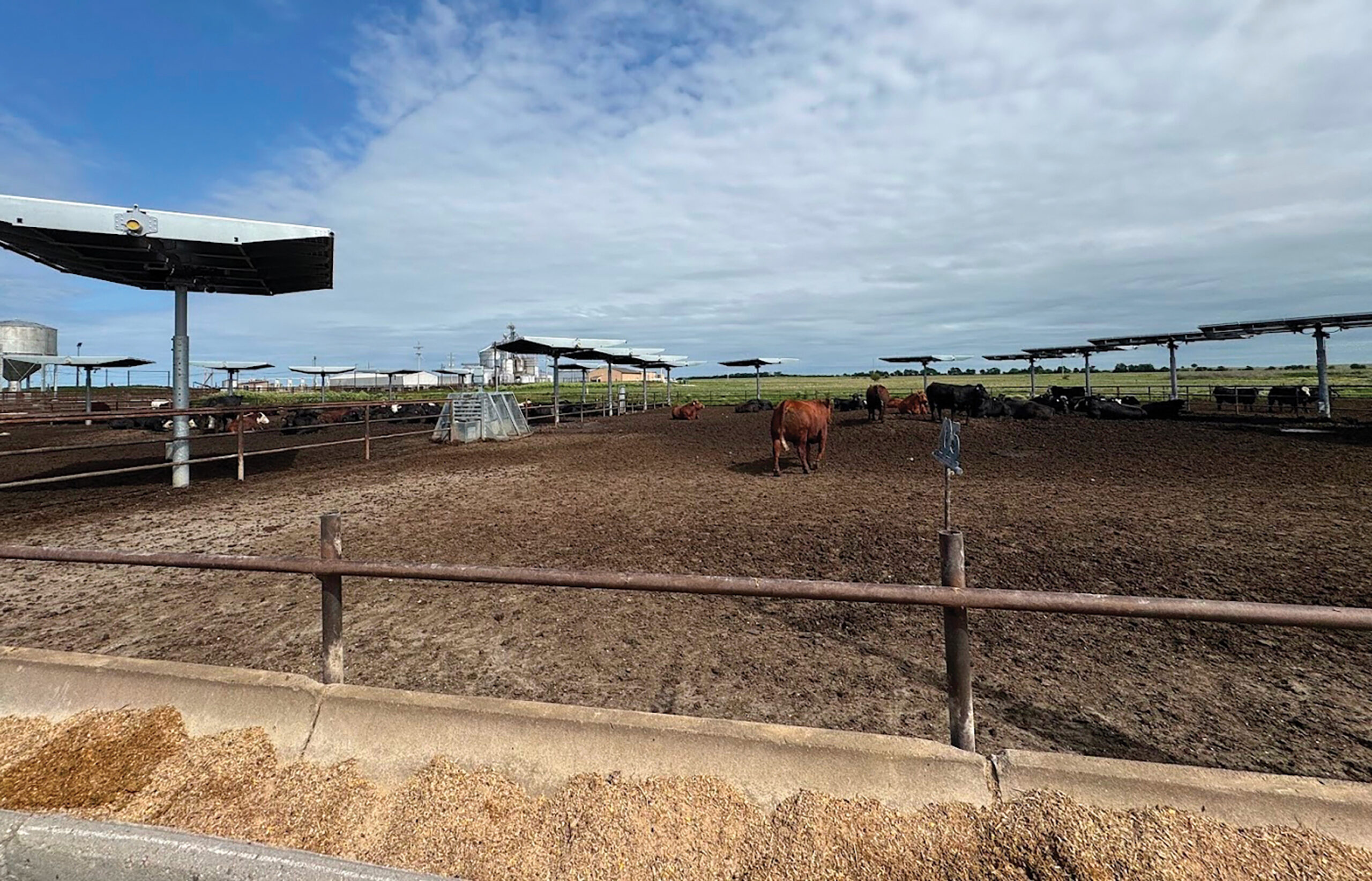
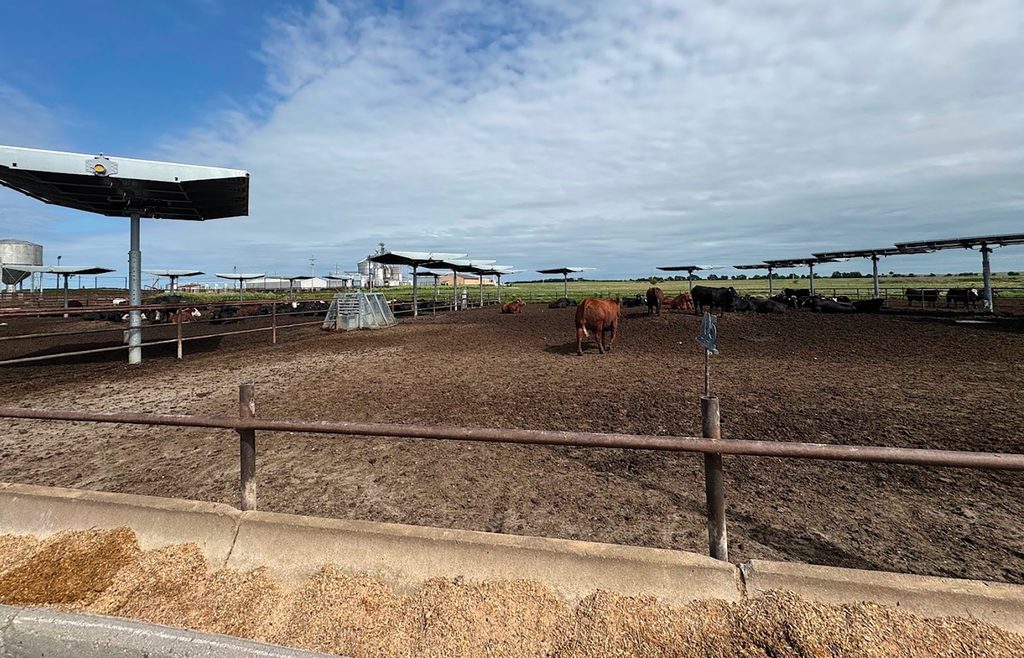
In feedlots, dairies, and other confined animal feeding operations, heat stress is a serious economic and animal welfare issue. Cattle do not eat as well when they are overheated, and extreme heat events can be deadly. McKinion pointed to major cattle death-loss events in Kansas as an example of the risk producers face.
Helical Solar’s elevated arrays can provide shade while producing power. Unlike temporary fabric shade structures, which can be vulnerable to high winds, the company’s system is engineered to withstand 125-mile-per-hour winds when stowed. Built-in accelerometers can detect wind events and move the panels into a safer position.
That combination (shade, power production, and durability) could create value in places where conventional solar is not practical.
Pilot Projects and Funding
One of Helical Solar’s current pilot projects is in Kansas, supported by the USDA. The pilot includes 21 systems across two pens, producing 122.9 kilowatts. McKinion said that if the same density were scaled across the entire operation, which includes about 200 pens, 19,000 head of cattle, and 40 acres, it could represent roughly a 7.5-megawatt solar power plant.
“It’s not small when you start looking at it, sort of building that out,” he said.
To date, Helical Solar has been funded through U.S. Department of Energy and USDA grants. McKinion said the company is now looking to raise an initial seed round to commercialize the technology, scale the business, and pursue larger projects. The engineering has been de-risked through grant-backed development, he said, but the company still wants additional pilot projects and third-party validation, especially around the agronomy side.
That validation will be critical. Farmers, ranchers, and feedlot operators may appreciate the concept, but McKinion knows that slides and renderings only go so far.
“They want to see something, real steel in the ground,” he said.
Helical Solar is exploring potential pilot opportunities with universities, including the University of Nebraska-Lincoln, and is also looking at markets such as California’s Central Valley, where dairy operations face real shade requirements.
But McKinion’s larger vision reaches beyond individual farms or feedlots.
Powering AI Data Centers Without Taking Land Out of Production
He sees an opportunity to connect Helical Solar’s farmer-first model with the massive power needs of AI data centers. Instead of building a single large solar development that takes farmland out of production and triggers local resistance, McKinion imagines aggregating smaller agrivoltaic projects within a five- or 10-mile radius of a data center.
In that model, farmers and ranchers could choose whether to participate. Those who opt in could receive steady lease-style revenue while continuing to farm or raise livestock. The data center could receive localized power without relying as heavily on long high-voltage transmission lines or waiting years in crowded interconnection queues.
For rural communities, the arrangement could feel less like an outside project being imposed on them and more like a partnership.
“When you start looking at large projects, 100 megawatts or whatever, that’s several million dollars in carrying costs that they can avoid just by pulling that in one and a half to two years,” McKinion said.
McKinion believes that kind of recurring income could help stabilize U.S. agriculture, especially as farmers face weather volatility, tariffs, tight margins, and other risks outside their control.
“It would do a lot to stabilize U.S. agriculture and de-risk from weather and tariff events,” he said.
Time is another major part of Helical Solar’s value proposition. AI data centers need power quickly, and many traditional energy solutions face long timelines. McKinion said small modular reactors remain years away from broad deployment, while gas-fired power plants can face long equipment waitlists. Solar is one of the few options that can be deployed within the timeframe many data center developers need.
Even then, McKinion believes Helical Solar can move faster than conventional solar because its system does not require the same level of site grading or concrete foundation work. The helical pile system can adapt to varied terrain, potentially shortening deployment timelines and reducing costs tied to grading, permitting, and end-of-life remediation.
He said the company’s system could pull project timelines forward by 18 to 24 months in some cases.
The technology also offers an end-of-life story that is easier to explain to landowners. Instead of excavating concrete or pulling out I-beams, Helical Solar’s ground screws can be removed and either reused or recycled.
The Road Ahead
To McKinion, the value of the system is not just about price per watt. It is about the entire lifecycle: installation, power production, agricultural compatibility, landowner acceptance, deployment speed, and eventual removal.
Helical Solar is still a young company, but its central idea feels especially timely. The country needs more power. Agriculture needs more resilience. Rural communities need projects that respect the land and the people who work it.
McKinion believes those needs do not have to compete with one another.
With the right design, he believes solar can become a tool that helps farmers stay on the land, helps livestock producers protect their animals, and helps the next generation of energy-intensive industries meet their power needs without leaving rural communities behind.
That is the future Helical Solar is trying to build: not solar instead of agriculture, but solar built around it.
HELICAL SOLAR
helicalsolar.com