Photos Provided by Wyatt Arnold
Tiny Particles, Big Questions
Prospect Growth’s roots are in university research, its team is small, and its technology is still moving through field validation. But its target is better nutrient delivery, fewer losses, and a fertilizer product that solves real agronomic problems without asking growers to change the way they farm.
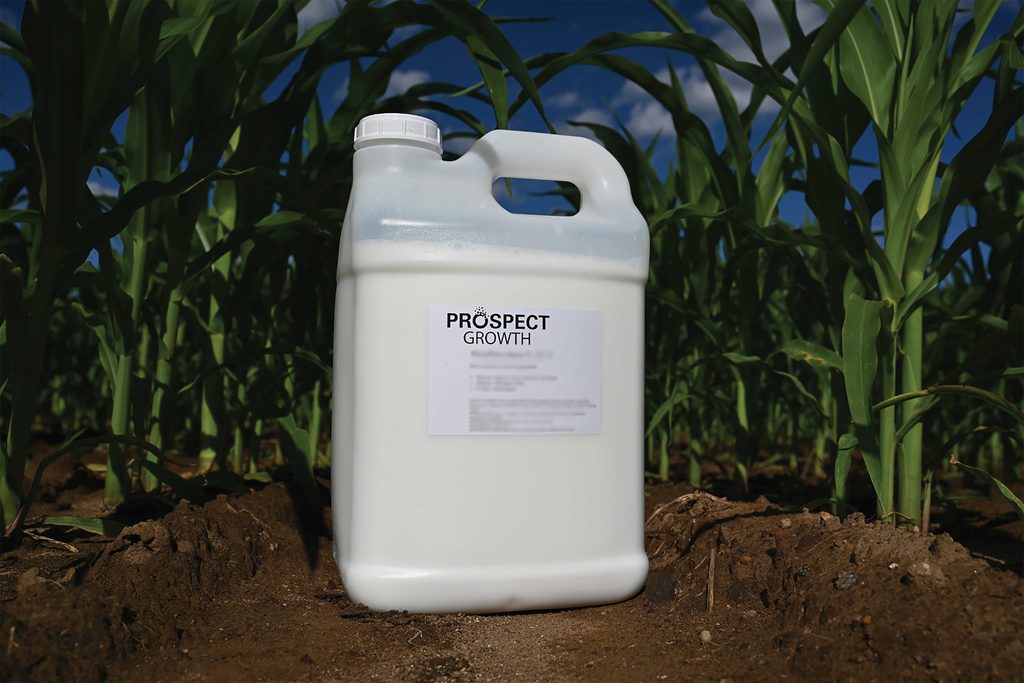
Prospect Growth is developing nanoparticle-based fertilizers, or “nanofertilizers,” built around ultra-small solid particles designed to carry nutrients into crops in a more efficient, crop-available form. The company describes the goal as nanoscale engineering for acre-scale impact, not necessarily making fertilizer cheaper, but making each dollar spent on fertilizer go further.
Wyatt Arnold, co-founder and CEO of Prospect Growth, said that most fertilizers supply nutrients as soluble salts. Those products work, he said, but they also have familiar limitations. Nutrients can bind up in the soil, move where they are not wanted, or become unavailable before the plant can make full use of them. “If we want to get more yield out of things,” Arnold said, and “get less nutrients into the environment,” agriculture needs new ways to supply fertility.
Prospect Growth’s answer is to deliver nutrients as tiny, solid, water-dispersible particles rather than as dissolved ions. According to the company, these particles are engineered at the nanometer scale, giving Prospect Growth more control over nutrient composition and release. The particles are intended to enter plant tissues and release nutrients gradually, which could reduce loss pathways and better match nutrient supply with crop demand.
The concept is not that mineral fertilizer is going away. In fact, Arnold is explicit that it is not.
“I think biologicals will be a huge part of that,” he said, referring to the future of crop nutrition. “But I don’t think that means we can ignore the mineral fertilizers.”
From Lab Idea to Field Question
The company’s technical challenge is not simply making tiny particles. Researchers have known how to make nanomaterials for years. The hard part is making them consistently, safely, affordably and at a scale that matters to agriculture.
Arnold said previous approaches tended to fall into two categories. Some could make consistent particles, but only with expensive inputs, high energy use, high pressure, high heat, or other processes that did not fit commodity agriculture. Other approaches, such as grinding a material down until it became extremely small, could be cheaper but less precise. Prospect Growth is trying to fill the space in between.
The company’s path traces back to Yale University. In 2024, Yale’s Center for Business and the Environment listed Prospect Growth, led by Wyatt Arnold and Andreas Backhaus, among winners of the Sobotka Seed Prize for Sustainable Ventures, describing the venture as a maker of nanoparticle-based fertilizers intended to increase yields while reducing nutrient inputs and losses. Prospect Growth also received the Audience Choice Award at Startup Yale 2024, where Yale described its work as low-cost, scalable production of nanofertilizers.
The Yellow-Soybean Problem
One of Prospect Growth’s most practical early targets is iron deficiency chlorosis, or IDC, in soybeans.
For growers in affected areas, IDC is not an abstract nutrient-efficiency problem. It is the yellowing that shows up in patches, often early in the season, when soybean plants cannot access enough active iron even though the soil may contain plenty of total iron. According to NDSU Extension, North Dakota soils have sufficient iron, but carbonates, commonly showing up in soils with pH above 7, can make iron unavailable to soybeans. IDC symptoms include yellow leaves with green veins, and early-season yellowing, browning, and stunting can reduce photosynthesis and yield.
University of Minnesota Extension similarly describes IDC as a recurring problem in parts of Minnesota, especially in south central, southwest, west central, and northwest production regions. Iron is needed for chlorophyll formation, but in higher-pH soils, especially those with calcium carbonate, iron becomes less soluble and harder for the plant to use.
Arnold explained the regional issue in grower-friendly terms. Soybeans in the area can be productive, but are “kind of bad at pulling iron from the soil,” he said. In former lakebed soils, calcium deposits can help keep iron tied up, leaving beans yellow because they cannot make enough chlorophyll.
That is not a new problem, and growers already have management tools. Variety selection remains a first line of defense. In-furrow ortho-ortho EDDHA chelate products can help, especially in fields or zones with a known IDC history. But those treatments add cost, and IDC does not always show up evenly or predictably across a field or from year to year. There is also a key limitation of foliar chelates, they may green up the tissue they contact, but new growth can remain yellow because iron is not mobile in the plant.
That limitation is exactly where Arnold sees an opening.
With conventional foliar iron, he said, “you’ll green it back up, but then the new growth will just have the chlorosis issue again.” Prospect Growth is testing whether an iron nutrient delivered as a tiny particle can behave more like a slow-release source inside the plant. Arnold compared it to a slow-release pill, or even an ice cube moving through the body while it releases water. The goal is not to make iron move everywhere in the plant, but to improve its persistence and mobility enough that a single timely spray could have a longer benefit.
Timing the Treatment
The timing matters. Arnold said Prospect Growth likes the idea of an early rescue treatment around the V2 stage in soybeans, after the second true trifoliate emerges. That window matters agronomically because earlier treatment gives the plant more time to recover, and it matters operationally because it may align with a post-emergence herbicide pass, limiting the need for a separate trip across the field.
“If you can get the iron in early after you see the IDC, the plant can utilize it and recover,” Arnold said. Wait too long, and the crop may take up the nutrient but still struggle with the compounded damage of early stress.
Early Signals, Not Sweeping Claims
Prospect Growth is not yet presenting its technology as a finished answer for every acre. Arnold was careful not to promise a blanket yield increase.
Agriculture, he said, is too variable for that.
“I really don’t like being like, ‘Oh, it’s going to be a 7% yield increase everywhere,'” Arnold said. “Everybody has their own conditions.”
Instead, the company is looking for problems where the pain is clear enough, and the value proposition is strong enough, to justify early adoption. Iron for IDC is one candidate. Phosphorus efficiency is another.
On the iron side, Arnold said small-plot work showed Prospect Growth’s treatment resolving IDC symptoms better than current best-in-class iron fertilizers in early trials. He emphasized that those results came from one or two small-plot trials, not broad commercial-scale proof. On the phosphorus side, he said a corn research trial showed no significant difference between treated and untreated areas in leftover underutilized phosphate at the end of the season, while conventional phosphorus fertilizer rows showed a buildup of unused phosphorus. His interpretation is that early evidence suggests the company’s phosphorus material may be used more efficiently.
Looking for the Worst Offenders
For Arnold, the next step is not simply proving that nanofertilizers can work. It is finding where they matter most.
Iron may be easier to commercialize first, he said, because micronutrients require lower volumes per acre and may carry more margin in the material. A new phosphorus fertilizer could have a broader acreage opportunity, but the commercialization path is different. Prospect Growth is testing both because, as Arnold put it, a small company cannot afford to overlook an easy win.
That is also why the company wants to hear from growers.
Prospect Growth is not trying to push a technology into situations where it does not solve an acute problem, Arnold said. Instead, he wants growers to identify the fertilizer-related issues that hurt most on their farms.
“If somebody has a problem that they think is really painful, that’s where I’d honestly say, reach out and tell us,” Arnold said. “What kind of fertilizer-related issue is your worst offender?”
PROSPECT GROWTH
prospect.ag | LinkedIn: /prospect-growth