Photos Provided by Leaftech Ag
Listening to the Leaf
For decades, farmers have been told to make decisions based on data.
Soil tests. Yield maps. Weather models. Drone imagery. Satellite photos. Tissue samples. Application maps. The modern farm has no shortage of information.
But John Mascoe believes agriculture has still been missing one of its most important signals.
The plant itself.
“We measure plant characteristics through hyperspectral sensors,” said Mascoe, Co-Founder and CEO of Leaftech Ag. “Initially, we are using it to determine nutrient content of a leaf and leaf water content.”
The problem Leaftech is trying to solve is that traditional plant tissue testing takes time. A farmer or agronomist collects leaves, sends them to a lab, waits days for results, and then tries to make a decision based on information that may already be outdated.
Leaftech Ag is trying to collapse that timeline from days to minutes.
From Days to Minutes
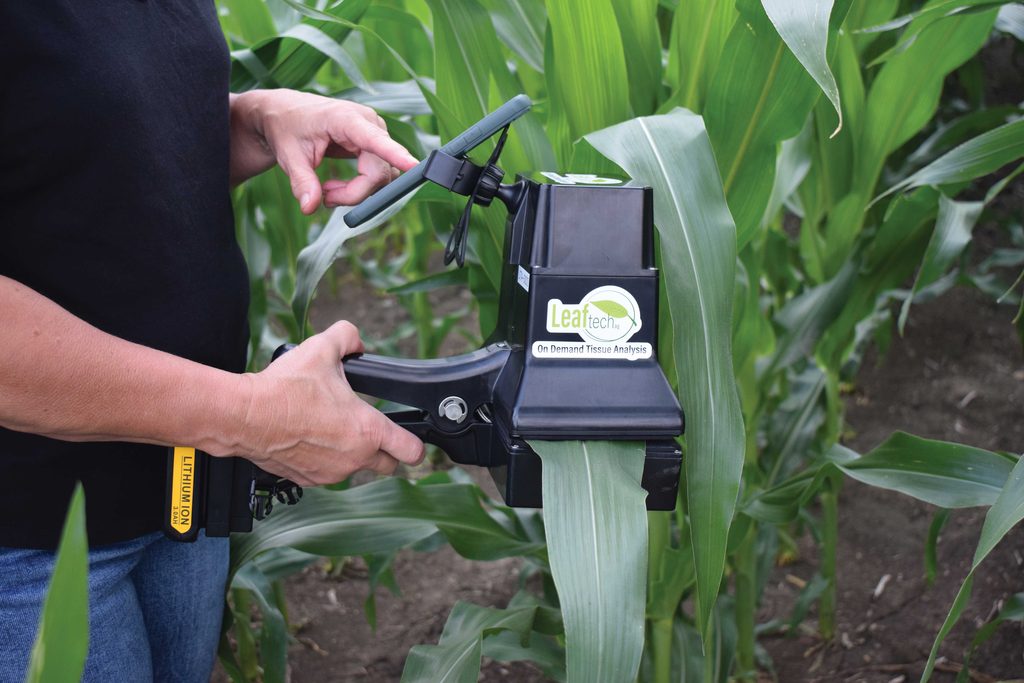
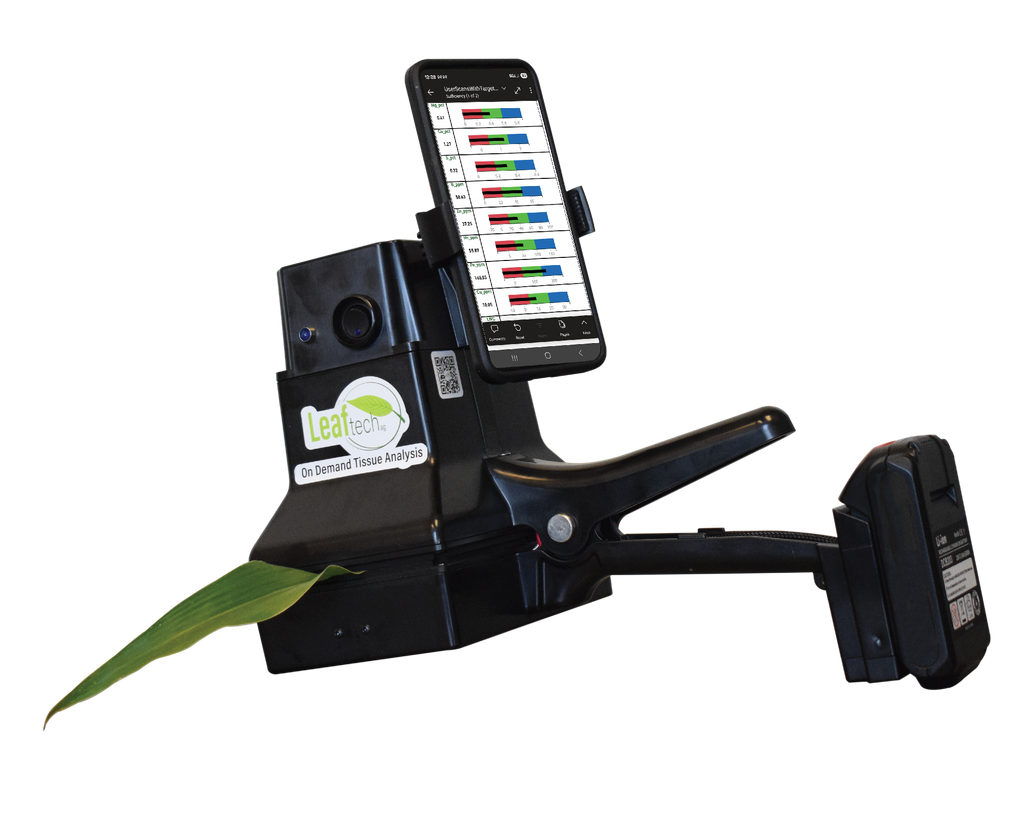
The company’s handheld scanner clamps onto a leaf, pushes light through the plant tissue, and uses hyperspectral sensing to analyze what is happening inside the plant. In less than 10 seconds, it captures the scan. Within roughly two to five minutes, users can see information on all macro and micronutrients, along with leaf water content, through a user interface.
For Mascoe, that speed is not just a convenience. It changes what is possible.
Plants are not static. Nutrient levels move with water. Uptake changes throughout the day. Stress, soil conditions, compaction, biological activity, weather, and management decisions can all influence what a plant is able to take in and use.
Mascoe compares it to blood sugar in a diabetic.
“It changes based upon what’s going on,” he said. “Same thing with a plant.”
Why Accuracy Is the Wrong Question
That dynamic nature is one reason Mascoe is careful when people ask how LeafTech compares with a lab. On paper, the question sounds straightforward: Is it as accurate as traditional tissue testing?
Mascoe does not see it that way.
“That is a very loaded question,” he said. “Who’s accurate? Who sets the standard for accuracy?”
As Leaftech has compared lab results, Mascoe said the company has seen significant variation between certified labs, even when the same material is sent for testing. His point is not that labs are useless. It is that the industry often treats lab numbers as absolute, when in reality they can vary.
Leaftech’s strength, he said, is its ability to measure change and trends consistently, quickly and repeatedly.
“We measure change and trends exceptionally well,” Mascoe said. “We can replicate a lab’s data up into the 90th percentile. It’s just whose lab.”
That distinction matters because Leaftech is not here to replace the labs, but to enhance the information farmers receive. It is trying to give farmers and agronomists a new way to observe a living crop in real time.
A Non-Destructive Way to Track Change
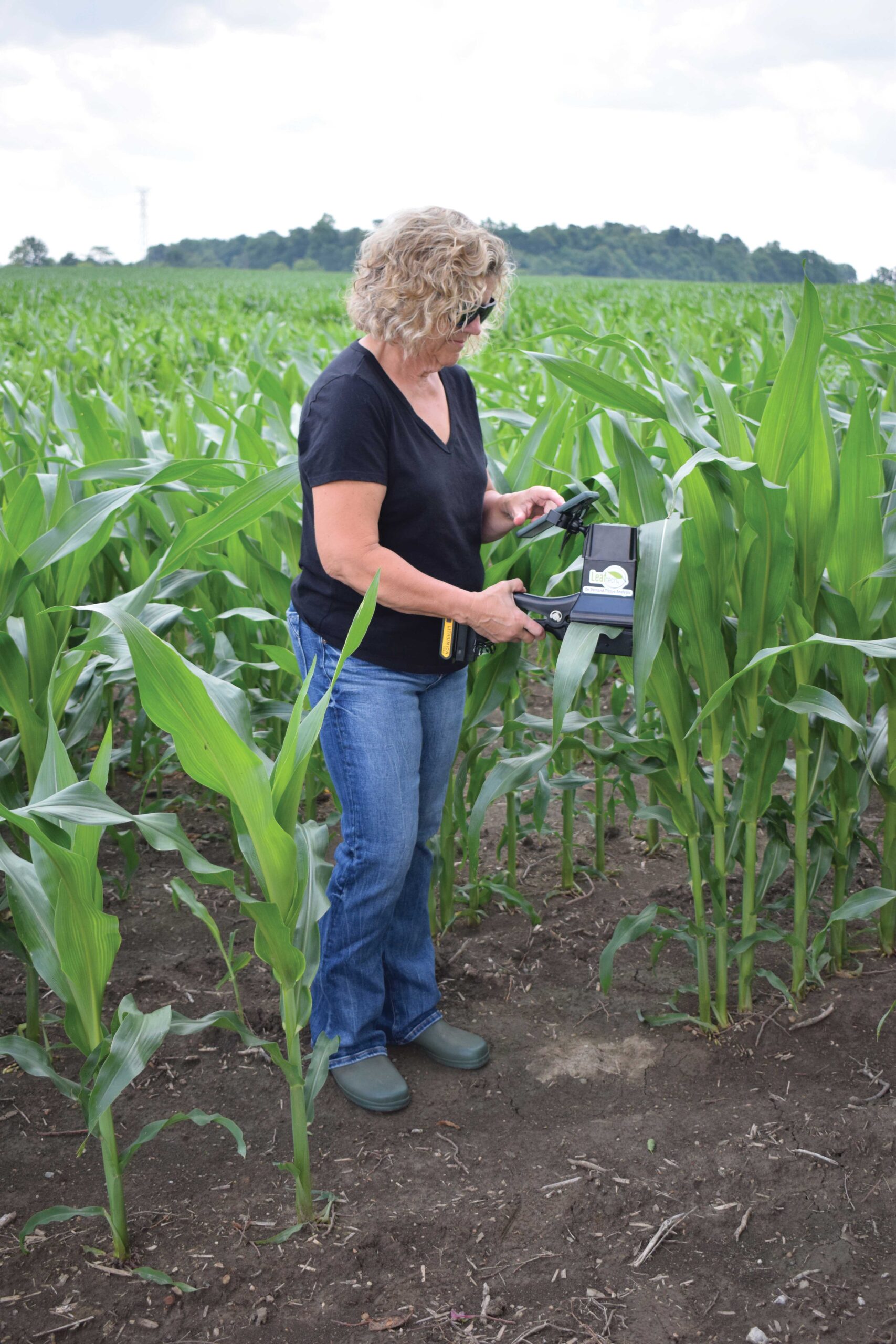
One of the biggest advantages is that the scanner is non-destructive. A traditional tissue sample removes leaves from the plant. Leaftech allows users to scan the same plant again and again. A farmer could scan before an application, return three days later, and scan the same area to see whether the plant responded.
Each scan is also georeferenced, creating a location-specific record of what is happening in the field.
That opens the door to a different kind of crop management. Instead of relying only on assumptions, broad averages or delayed reports, growers and crop advisors can begin to see where nutrient uptake is strong, where it is lagging, and how different parts of a field are responding to management decisions.
“We can actually target apply the nutrients where they need to be in the right amount,” Mascoe said. “In addition, we can measure the efficacy of the products that are being used.”
That could mean testing whether a pint of a product moved a nutrient level 10% or 20%. It could mean comparing whether a higher rate created a stronger response. It could mean discovering that the real problem in a field is not the nutrient a grower assumed, but something else entirely.
“There’s no use putting a boron treatment on if really my problem is potassium,” Mascoe said.
Built to Complement, Not Replace
The technology is not designed to replace every other tool in the field. Mascoe sees drone and satellite imagery as useful, but incomplete. A drone may show that one area of the field looks different from another. It may reveal stress, variation, or changes in greenness. But, in his view, imagery often shows that something is happening after the fact without fully explaining why.
“The drone shows you there’s a problem,” Mascoe said. “It doesn’t tell you why.”
Leaftech’s role is to help answer that “why.”
A user can walk a grid pattern across a field, scan at set intervals, and build a more detailed picture of nutrient uptake. Or they can use a drone or imagery to identify zones of difference, then go into those zones with Leaftech to diagnose what is happening at the plant level. Or they can use it more specifically to investigate a problem area, test a product, or measure the effect of a management decision.
“You could do three scans a minute,” he said. “If you’re out there tissue sampling anyway and you’re doing 20 leaves, you can actually do 100 to 1,000 leaves in the time it takes you to go do that one sampling.”
Growing as a Family Business
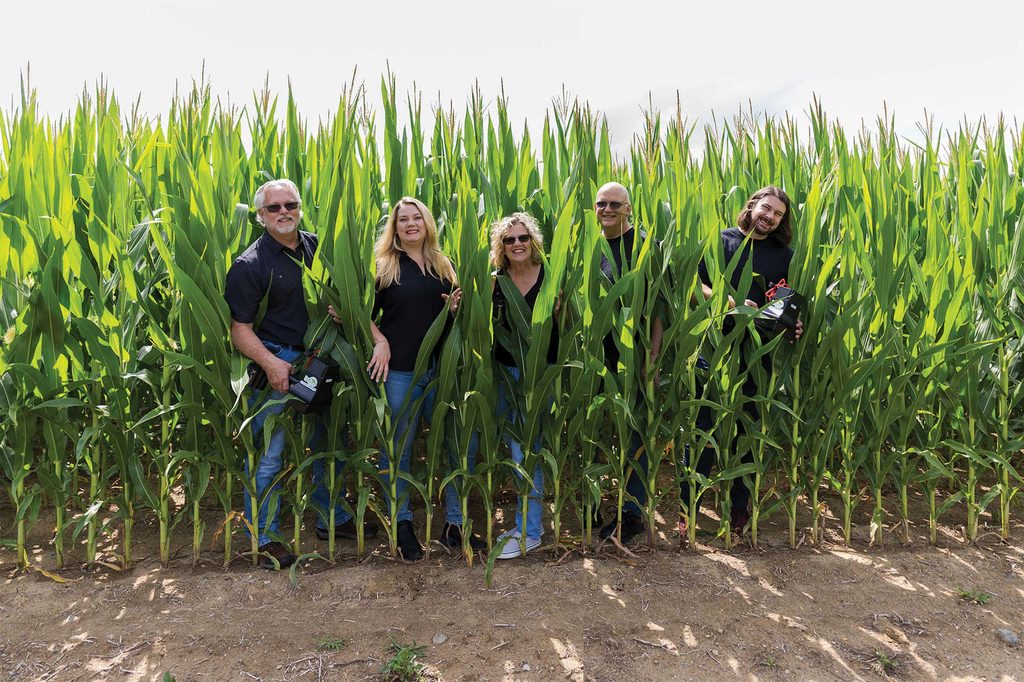
The company itself is still young, but it has moved beyond the idea stage. Leaftech started in 2020 and has grown organically as a family business. Mascoe said the company is self-funded today and not actively raising capital. It works with growers, ag retailers, crop consultants and industry partners testing products, but the main buyer so far has been ag retailers and crop consultants who can use the technology to provide better service and better recommendations to farmers.
The company has about 11 employees and is growing. Mascoe said Leaftech has completed more than 300,000 scans across North America, including the United States and Canada, and has expanded into Australia, with additional testing in other regions.
“We only wanted to grow as fast as we can handle,” Mascoe said. “Right now we’re straining, but that’s a good thing.”
Leaftech’s business model also reflects Mascoe’s experience in precision agriculture. He has worked in the space since 1996, helping bring new tools such as soil moisture probes, disease and pest modeling, and weather networks into the marketplace. Over the years, he has seen technologies with real promise fail because they were poorly supported after the sale.
Leaftech is structured as hardware as a service. Customers do not simply buy a device and hope it stays relevant. Because the technology is changing quickly, Leaftech wants users to have access to the latest version each season.
Mascoe said that model also keeps the company accountable.
“We have to earn the right to be on their business every year,” he said.
From Drip Irrigation to a Missing Link
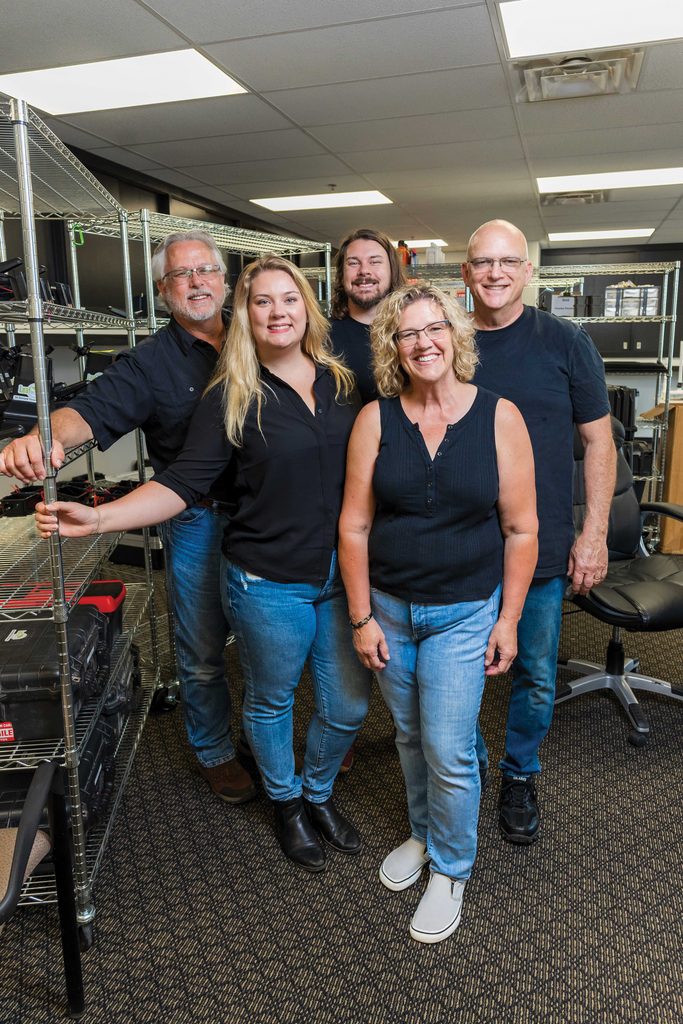
The origin of Leaftech came from Mascoe’s search for a missing link. While working in the drip irrigation industry, he saw that growers could treat specific zones of a field but did not have a fast enough way to understand what was happening inside those zones.
He and his son began looking for technology that could provide that answer. When they could not find exactly what they needed, they built it.
“My son and I literally found a good sensor and built around that ability,” Mascoe said.
The goal was to create something practical. Farmers and agronomists would not scan 10 or 15 spots on a leaf if the process was slow or awkward. They needed to clamp, scan and move.
“Our job is to make the information gathering simple, the integration of that data easy, so that a decision can be made based upon what needs to happen,” Mascoe said. “It has to be actionable.”
The 4Rs and What Comes Next
Mascoe is not interested in data for data’s sake. He wants information that helps farmers make better decisions about nutrient management, input use, product selection, and field variability. In many ways, Leaftech is built around the long-discussed promise of the 4Rs: right product, right nutrient, right location, right amount, and right time.
“We’ve made that goal achievable,” Mascoe said. “Everything that we’ve been preaching about targeted nutrient management at the right time, we give the way to deliver on that promise.”
The long-term potential may go beyond nutrients. Because Leaftech captures large amounts of hyperspectral data, Mascoe believes the company may eventually be able to identify additional plant characteristics, disease signatures and other patterns that are not yet fully understood. If the company discovers a useful signature years from now, it may be able to go back and reprocess historical scans to understand trends that were invisible at the time.
Mascoe sees possibilities in soil analysis, robotics, artificial intelligence, and other applications. But he also pushes back against the idea that the future is the only exciting part.
“We shortened the time frame from getting the data from a lab from three to 14 days to five minutes,” he said. “Isn’t that impressive enough?”
It is.
Listening to the Crop
After more than 30 years in agronomy and precision agriculture, Leaftech is showing him things that challenge what he thought he knew. Nutrient uptake curves look different. Time-of-day movement looks different. Plant behavior does not always follow the book.
“I’m seeing a lot of things that are making me question what I thought I knew,” Mascoe said.
That may be the larger promise of Leaftech. It is not just a scanner. It is a way to listen more closely to the crop.
For generations, farmers have walked fields, watched plants, trusted experience, and made decisions based on what they could observe. Then agriculture entered the age of digital tools, remote sensing and large-scale data. Leaftech is trying to bring those worlds together: the old habit of walking a field and the new ability to quantify what is happening inside the plant.
Mascoe believes that kind of information could lead to more precise applications, better product performance, stronger nutrient stewardship and a deeper understanding of the biological systems that drive crop production.
“We’re taking the basics and making it easier,” he said.
In other words, Leaftech is not asking agriculture to stop trusting the field.
It is giving the field a clearer voice.
LEAFTECH
leaftechag.com