Photos Provided by Spornado
Catching Disease on the Wind
A field can look perfectly healthy while trouble is already moving through it.
By the time a grower sees the first lesion, patch of mold, or dusting of rust, the best window for prevention may already be narrowing. Fungicides are most effective when applied before many fungal diseases become established, yet growers often have to make that investment before the crop provides a visible answer.
Spornado was built for that gap.
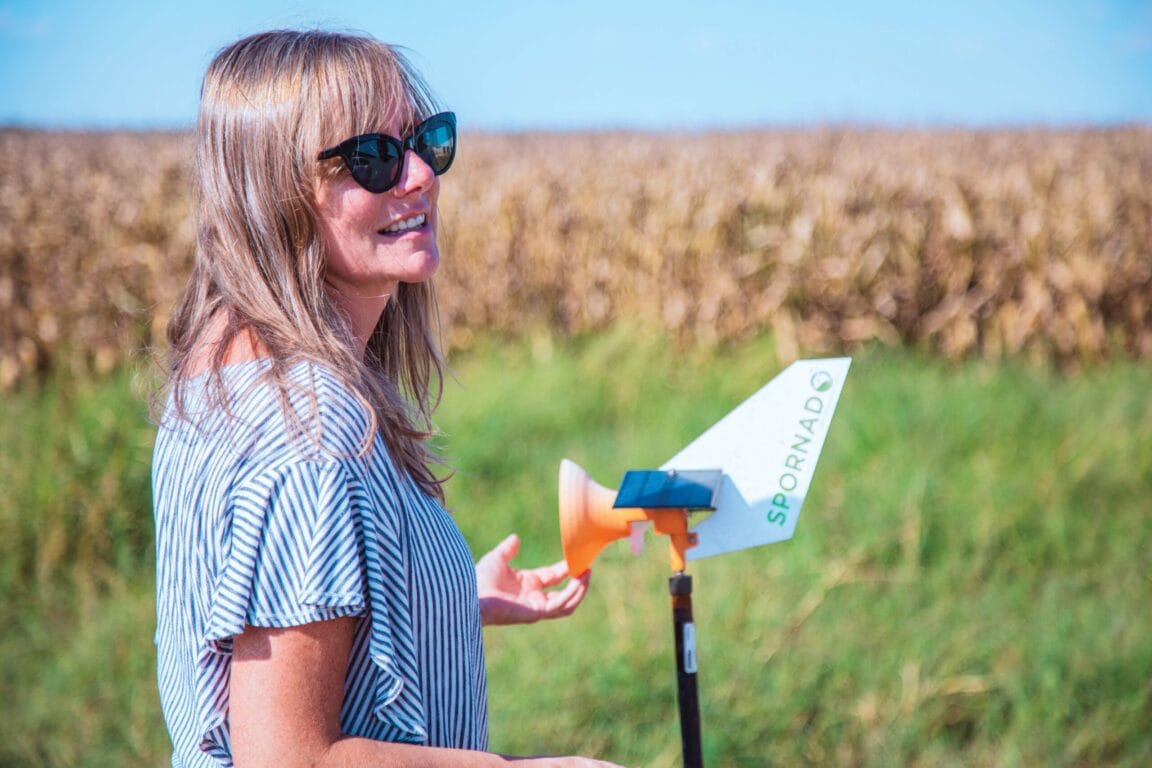
“What we do is provide an early alert for fungal crop disease,” said Kristine White, CEO and co-founder of Spornado. “Farmers, in the past, have used a lot of guesswork on when to spray. The thing with these chemicals is they work best preventatively.”
The Toronto-based agtech company places a compact air sampler directly in the field, where it collects airborne spores on a replaceable cassette. The cassette is sent to one of Spornado’s partner laboratories for targeted molecular analysis. The resulting report tells the grower whether DNA from a specific pathogen has been detected, potentially two weeks or more before symptoms become visible, according to White.
Finding the Missing Piece
Plant pathologists often describe crop disease through the “disease triangle”: a susceptible host, a favorable environment, and the presence of a pathogen. Growers generally know what crop and hybrid they planted, while weather stations and forecasting models can show whether conditions favor disease. The pathogen itself, however, can remain invisible.
Spornado is designed to measure that missing piece.
The passive sampler relies on wind to draw airborne material onto a specialized filter. This is augmented by a small solar-powered fan. Once the laboratory receives the cassette, targeted DNA testing can detect very small amounts of the pathogen, with results available in as little as one day. The field hardware does not need to change when a grower wants to monitor a different disease; the laboratory changes the molecular test used to analyze the cassette.
Spornado now has tests for approximately 30 diseases across 15 crops, White said. Corn, soybeans and potatoes currently account for the company’s largest areas of use, although the system has also been applied in wheat, barley, canola, sugar beets, grapes and several fruit and vegetable crops.
Samples are typically collected once a week. Some potato operations and vineyards, where crop value, disease pressure or sharply different microclimates justify closer monitoring, submit cassettes twice weekly.
For growers seeking field-specific information and tighter spray decisions, White generally recommends one sampler for every 100 to 150 acres. Grower associations, agricultural retailers and other organizations can also establish regional networks. Those broader networks function more like radar: they can warn growers that a pathogen is moving into an area, but they are not a substitute for field-level data, scouting or consultation with an agronomist.
“You wouldn’t want to get a negative several miles away and then decide not to spray,” White said. “But it gives you an idea of what’s going on in your region. If it starts to be an issue, maybe you go out and scout more. Maybe you start looking at what to do.”
Built for a Row-Crop Budget
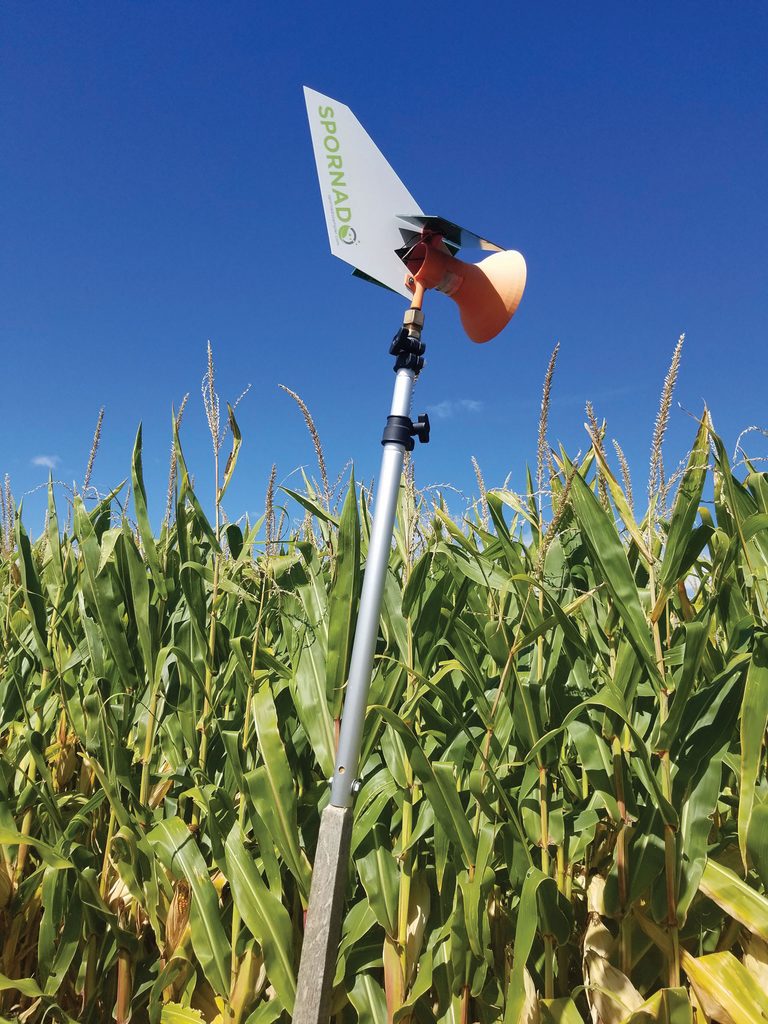
An agricultural technology can produce valuable information and still struggle to gain adoption if its cost or complexity does not fit the farm. Spornado’s founders designed the system to be simple enough to install without specialized training and affordable enough to use in crops with tight margins.
In the seasonal program White described, a grower monitoring a couple of diseases for approximately 10 weeks could expect to spend roughly $2,000 to $2,400. That includes use of the sampler, mounting pole, cassettes, and laboratory analysis. The grower can keep the sampler for the following season or return it with the final samples if the service is not a fit.
The result is less a traditional equipment purchase than a bundled monitoring service.
“Row crops have tight margins,” White said. “So, it was really important that it not be expensive.”
A laboratory result does not automatically tell a grower to apply, or skip, a fungicide. It gives the grower and agronomist another independent piece of evidence to consider alongside crop stage, weather, variety susceptibility, disease history and field observations.
That independence can be especially valuable when the person making a recommendation is also associated with a retailer or crop-protection company.
“When they have an independent lab report that shows, ‘OK, here there is, or isn’t, a problem,’ I think it really helps the conversation and helps build trust,” White said. “It’s not the person just selling you the stuff saying you should use more.”
From Buildings to Fields
Spornado emerged from expertise that initially had little to do with row crops.
White, Michael Saleh, and Dr. James Scott were environmental scientists specializing in fungal sampling and detection. White spent more than 20 years working with indoor fungal contamination and leading technical teams at environmental engineering firms. Saleh, now Spornado’s chief technology officer, specialized in fungal air sampling and laboratory management. Scott, the company’s chief scientific officer, is a plant pathologist and University of Toronto professor specializing in fungal biology.
The three were approached by an agricultural company seeking a way to detect Phytophthora infestans, the pathogen that causes potato and tomato late blight, in air and water without requiring electricity in the field. Working with growers, engineers, plant pathologists, and microbiologists, they developed the sampler that became Spornado. The technology was commercialized in Ontario in 2018, with broader deployment beginning after several years of prototyping and field validation.
Potato late blight provided the starting point, but the underlying approach proved adaptable. Many important crop pathogens have already been studied extensively, and disease-specific molecular tests have been published by researchers. Spornado can optimize those tests for use with material captured by its sampler rather than developing an entirely new field device for every crop-disease combination.
A published Canadian evaluation found that passive Spornado samplers paired with molecular detection methods could provide useful early surveillance of late blight in potato and tomato production areas, including detections before the first reported field symptoms in the respective regions.
White said Spornado has now deployed approximately 1,600 samplers in 23 countries, with most located in North America and the United States representing its largest market. In 2025, the technology received the Innovation in Agriculture Award in the Agronomics category at Canada’s Outdoor Farm Show.
A North Dakota Connection
Although Cultivate 2026 was White’s first opportunity to visit Fargo and Grand Farm in person, Spornado’s connection to North Dakota extends back years.
The company has worked with Grand Farm since the organization’s original farm site. For White, the value of that relationship is the opportunity to move technology out of a presentation and into an actual field, where growers, agronomists, researchers, and agricultural companies can see how it operates. Grand Farm’s broader model is built around that type of collaboration, connecting growers with startups, researchers, corporations, and other groups developing applied agricultural technologies.
Spornado samplers have also been used by North Dakota State University researchers. White pointed to work by longtime NDSU plant pathologist Dr. Gary Secor in sugar beets and potato agronomist Andy Robinson in potato production.
A 2025 report from Secor and fellow researchers described the use of Spornado traps and PCR testing in commercial sugar beet fields from 2021 through 2024. The samplers detected Cercospora beticola spores annually before crop emergence. The researchers concluded that Cercospora leaf spot forecasting should incorporate spore detection and early wetness conditions to help guide protective fungicide applications before infection appears.
Results from other regions also suggest that the information can influence real-world recommendations. In a 2022 canola project, Olds College of Agriculture and Technology reported that 83% of combined survey responses indicated Spornado results influenced the respondent’s fungicide recommendation. The project evaluated how laboratory results affected the timing, confidence, and final recommendation surrounding fungicide applications for sclerotinia stem rot.
Those findings do not mean every positive requires treatment or every negative eliminates risk. They illustrate the role Spornado is pursuing: providing information that was previously missing from the decision.
From Detection to Prediction
Spornado’s next stage is focused on making its information easier to use and more predictive.
The company has replaced handwritten sample forms with a mobile, QR code-based process. Growers can now access an online portal with graphs showing how spore levels change throughout the season. As its dataset grows, Spornado is also providing context about whether pathogen pressure is relatively low, medium or high.
The larger project brings artificial intelligence and machine learning into the disease triangle.
With support from a Canadian government grant, Spornado is combining historical spore results with weather models, crop-hybrid information and other agronomic data. Weather models indicate whether conditions favor disease, while Spornado’s results show whether the pathogen is present and how concentrations are changing.
White expected a white mold forecasting model to enter beta testing in late summer 2026, followed by additional disease models in summer 2027. At the time of the interview, those forecasts were still in development and were not included in the commercial grower service.
“A couple of years ago, it wouldn’t have been possible,” White said, noting that accessible machine learning makes it possible to analyze years of biological, environmental, and agronomic information.
The goal is not to eliminate uncertainty. Weather changes, pathogens move, and neighboring fields can behave differently. Instead, Spornado is trying to replace one unknown with a measurement.
“Growers have so much risk. They have so much unknown,” White said. “We’re trying to fill in some of that unknown and help them make the right decision.”
The field may still look clean. The air may already be telling a different story.
10% Off — Readers who mention this article and sign up for Spornado’s 2027 season by October 31, 2026 can receive 10% off. Growers should contact Spornado to confirm crop eligibility, program terms, and final pricing.
SPORNADO
spornadosampler.com | Facebook