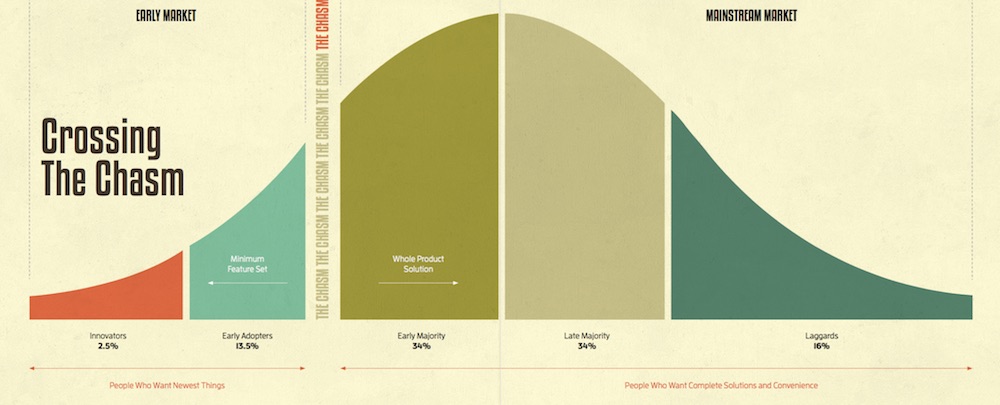
In 1991, Geoffrey Moore wrote a book called “Crossing the Chasm” that changed the way tech entrepreneurs look at the way technology is adopted by the public. This book expounded on the idea that, in terms of consumers, marketers often break them up into five different categories: Innovators, Early Adopters, Early Majority, Late Majority and Laggards.
Howard Dahl – the founder of Amity Technology and the grandson of E. G. Melroe, the founder of the Melroe Company, which developed the Bobcat Loader – might have a better way of classifying these consumers.
“There are three types of
people,” said Dahl. “Those who
make things happen. Those who
watch things happen. And those
who say, ‘What happened?’”
In “Crossing the Chasm,” Moore
went into detail about how the
toughest transition to make is
going from early adopters to
early majority.
When you apply this concept
to the full adoption of
automation in agriculture, this
model still holds up. As the
technology becomes more
mainstream, so too will the
use of the equipment. Right
now, Dahl believes that we are
in the innovators phase of this
technology adoption.
“The innovators are, at the most, two-three percent of the population of any industry,” said Dahl. “They’re the ones who say, ‘I want to be the first to do this.’ You have to have innovators to try various things. There will be bugs but they have to be patient with the things that are going to work out.”
Consumer demand has to be
there before anything can go
mainstream. However, Dahl and
Amity Technology has shown
that the demand is there from
farmers for automation in
agriculture.
“We had about 20 key sugar
beet farmers in for a focus group
for a day and on their wish list
was an autonomous sugar beet
defoliator and sugar beet cart,”
said Dahl. “They see the farmer
running in his harvester but then
the other two machines are
running autonomously. That was
their wish list.”
Dahl says that autonomous grain carts are very close and that we’re only four or five years from seeing significant growth in this field.
Why North Dakota Is Right For Grand Farm North Dakota is often seen as a conservative and traditional place but over its 130-year history, it has proven time and time again that it is ripe for innovation. Dahl’s grandfather Melroe kicked off that innovation by building the first successful manufacturing business in North Dakota. Out of that company emerged the Bobcat Loader, North Dakota’s iconic signature to the world.
After the company was sold,
Dahl’s father and uncle bought
control of Steiger Tractor and
watched it grow from $2 million
to $105 million in six years.
Out of Steiger emerged a very
talented engineer who created
Phoenix International, which
became Deere Electronics,
headquartered in Fargo. That
talented engineer was Barry
Batcheller who left Deere
to create Appareo, a rapidly
growing company spawning
numerous innovative products in
agriculture and aerospace.
“There’s been a tremendous innovative spirit in this region,” said Dahl. “A lot of it is the ethos of the area. You’re around people who say, ‘We can figure out how to do this.’ … Most of the young startups have mentors or advisors who are helping to guide them and helping to learn from the mistakes of people who have been there before.”
So the question is, can this
success of innovation continue?
Through Grand Farm and the
planting of the stake in the
ground that North Dakota is a
player in ag automation and
tech, it is likely that this will
continue.
“In 1958, both Bobcat and Steiger were founded,” said Dahl. “It took quite a while for significant growth but both became real game changers for the world. … Everything starts with a dream and an idea. It sometimes takes a while to perfect it but we also have extremely talented farmers in this area and the task for the companies in Grand Farm is to listen to these very intelligent farmers and not assume we have a better idea than they do about what they need and what they’ll use.”
This chart shows how new technology is adopted by the public.
About Dahl
The President and CEO of Amity Technology, Dahl followed in the path of his grandfather and entered into the ag tech field. After graduating with a B.S. degree in business administration from UND, he received an M.A. in philosophy of religion from Trinity Evangelical Divinity School. In 1977, he started Concord, Inc. with his brother Brian that became the leading manufacturer of air drills. In 1996, Concord, Inc. was sold to Case Corporation. After selling Concord, he started Amity Technology, which produces sugar beet harvesters, defoliators and beet carts.